Loading
Cigar & Smoking Accessories
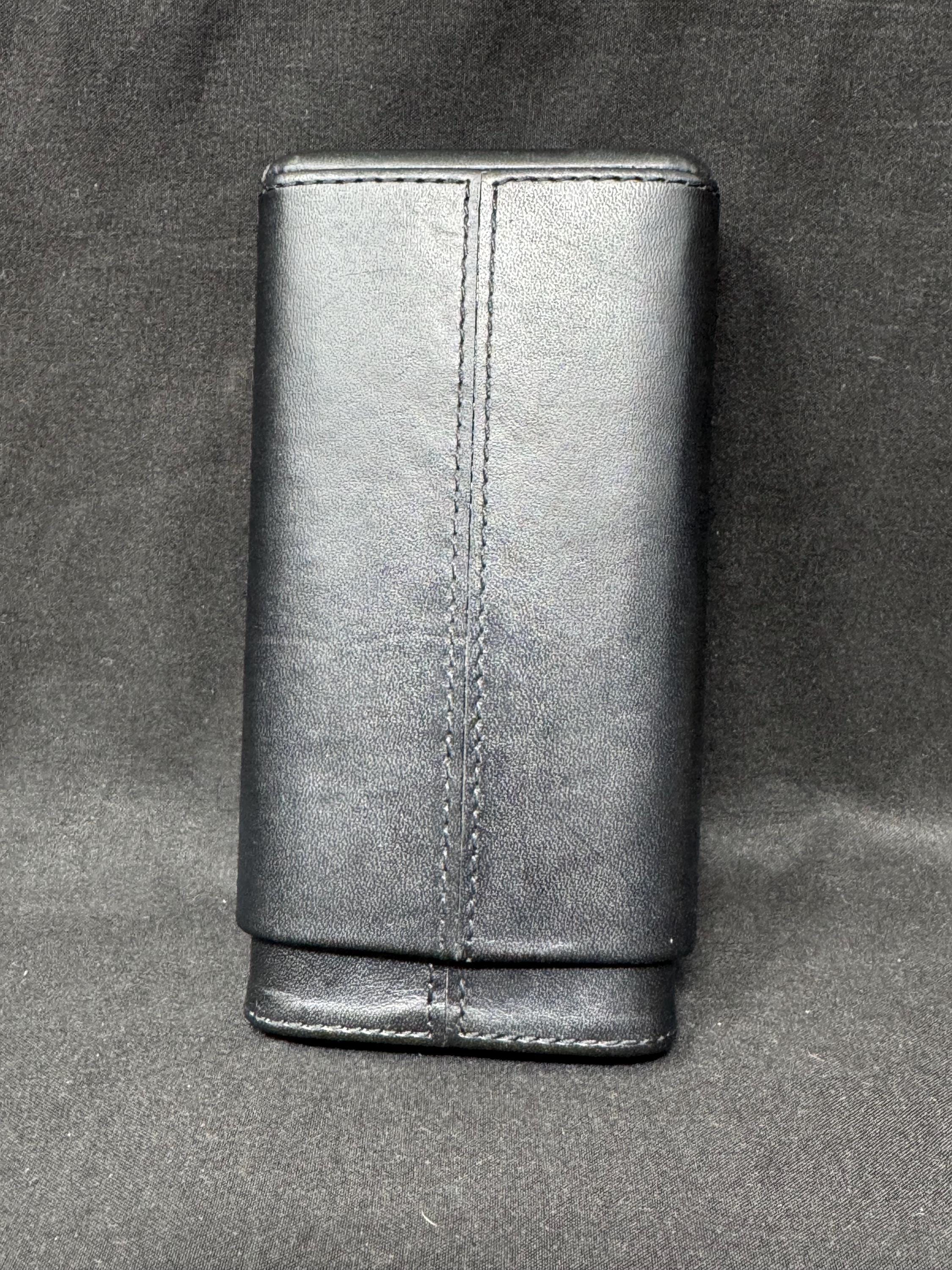
The Anomaly | A Rare German “Dual-Cocoon” Cigar Holder | Unlined & Uncompromised | c. Mid-20th Century .SKU-272
$45.00
The Anomaly
Material
Briar
Availability
Sold
Tags
SKU-272SmoothstraightbilloardpipegermanestateamberstemBent
This piece has been sold and is no longer available.
Carefully Packaged
Authenticity Guaranteed
Free shipping over $150
About this Piece
The Anomaly | A Rare German “Dual-Cocoon” Cigar Holder | Unlined & Uncompromised | c. Mid-20th Century
5.5” German soft leather case. Two independent, undivided sleeves. Museum-grade hard lining. Unidentified master artisan stamp. New Old Stock.
---
THE OBJECT
You are examining an anomaly.
At first glance, it presents as a classic German soft leather cigar holder—conservative in silhouette, confident in proportion. But the moment you open it, you realize this object does not conform to expectation.
It is a Dual-Cocoon system: two separate, fully enclosed leather sleeves, nested independently within a single outer jacket. Both the outer cover and the inner sleeve are constructed from soft, black genuine leather of exceptional European tannage. Neither is divided. Neither is compartmentalized.
This is not a limitation. It is a liberation.
Unlike conventional cigar cases that dictate precise cigar placement via rigid slots, this piece offers pure volumetric freedom. You may carry three, four, even five slender vitolas. You may carry a single robusto wrapped in cedar. You may carry nothing tobacco-related at all—pens, precision instruments, a pocket journal, your daily essentials. The architecture adapts to you, not the reverse.
THE CONSTRUCTION
Between the outer leather and the inner sleeve lies a hidden structural interlayer. It is rigid. It is audible when tapped. It feels, under pressure, like thin-gauge bookbinder’s board or compressed organic fiber—the same material used in heirloom German jewel cases and bespoke instrument boxes from the mid-century . This is not modern pressed pulp. This is old-world substructure, providing armored protection without visible bulk.
When you hold this case, you understand immediately: this is not accessory work. This is furniture-making logic applied to pocket scale.
THE MARK
Inside the inner sleeve, blind-embossed into the leather, is a small geometric insignia:
Two converging lines forming an angle, enclosed within a square.
There is no name. No city. No silver standard. No tax stamp.
This is a master’s chop, not a factory stamp. It is the signature of an individual artisan or a small atelier—likely from West Germany (c. 1950s–1970s) , a period when boutique leather workshops still operated quietly, producing limited runs for discerning tobacconists .
The mark is intentionally modest. It was never meant to announce itself. It was meant to be recognized by those who already knew.
DATING & HISTORICAL CONTEXT
We can locate this piece through forensic material reading:
· The leather: Soft, full-grain, minimally finished. This is consistent with mid-century German vegetable-tanning techniques, prior to the widespread adoption of chrome-tanning for mass-market goods .
· The substructure: Compressed organic board. Used extensively in German luxury packaging and small leather goods from the 1920s through the 1960s, then gradually phased out in favor of synthetics.
· The design philosophy: Pure, unadorned, structurally expressive. This is the leather legacy of the Bauhaus-influenced generation—craftsmen who carried modernist principles into postwar applied arts .
A working date range: circa 1955–1975.
CONDITION REPORT
New Old Stock. Preserved in original protective box. Never carried. Never filled. The leather is supple, uniform, and free of cracking or bloom. The structural interlayer is intact, offering firm, reassuring resistance. The brass or nickel-plated hardware (if present) retains its original luster. The interior is immaculate.
This is not a restoration. It is a time capsule.
WHY THIS MATTERS FOR THE COLLECTOR
You are not merely acquiring a functional object. You are acquiring evidence.
The Pipe Collectors Encyclopedia—a destination I am building for connoisseurs, historians, and the perpetually curious—exists to document and elevate precisely such artifacts. Objects that do not fit neatly into brand catalogues. Objects that challenge assumptions about what German leathercraft produced.
This holder is a primary source.
It tells us that somewhere, in a small workshop, an artisan chose to:
· Reject the industry standard of divided interiors.
· Invest in costly, labor-intensive structural layering.
· Sign not with a name, but with a symbol.
We may never identify that artisan. But his work survives. And it speaks.
PROVENANCE
Acquired from the dissolution inventory of a closed German specialty tobacconist. The shop operated for decades; its final stock included pieces accumulated across multiple generations of manufacturing. This holder was found in its original box, uncirculated.
DIMENSIONS
· Closed case: 5.5” L x 3” H x 1” D
· Outer sleeve interior: 5” L x 3” H x 1” D
· Inner sleeve interior: 5” L x 2.7” H x 0.75” D
MATERIALS
· Genuine black calfskin leather (smooth finish, soft temper)
· Hidden organic-fiber structural interlayer
· Original protective packaging
SHIPPING & HANDLING
Insured parcel. Carbon-neutral packaging. Certificate of Authenticity included.
#GermanLeather #VintageCigarCase #UnmarkedArtisan #WestGermanCraft #LeatherArchitecture #PipeCollectorsEncyclopedia #NewOldStock #Tobacciana #CigarHolder #MidCenturyDesign #BauhausLeather #AnonymousMaster #HeirloomQuality #StructuralLeather #DualSleeve #SoftLeatherHardCore #ArtifactNotAccessory #TobaccoShopFind #ClosedShopInventory #GermanCraftsmanship #LeatherCollector #SmokingHeritage #FormFollowsFreedom
please check my other pipe list here:
https://www.ebay.com/sch/faridunhill/m.html?_nkw&_armrs=1&_ipg&_from
SKU: SKU-272