Loading
Estate Pipes
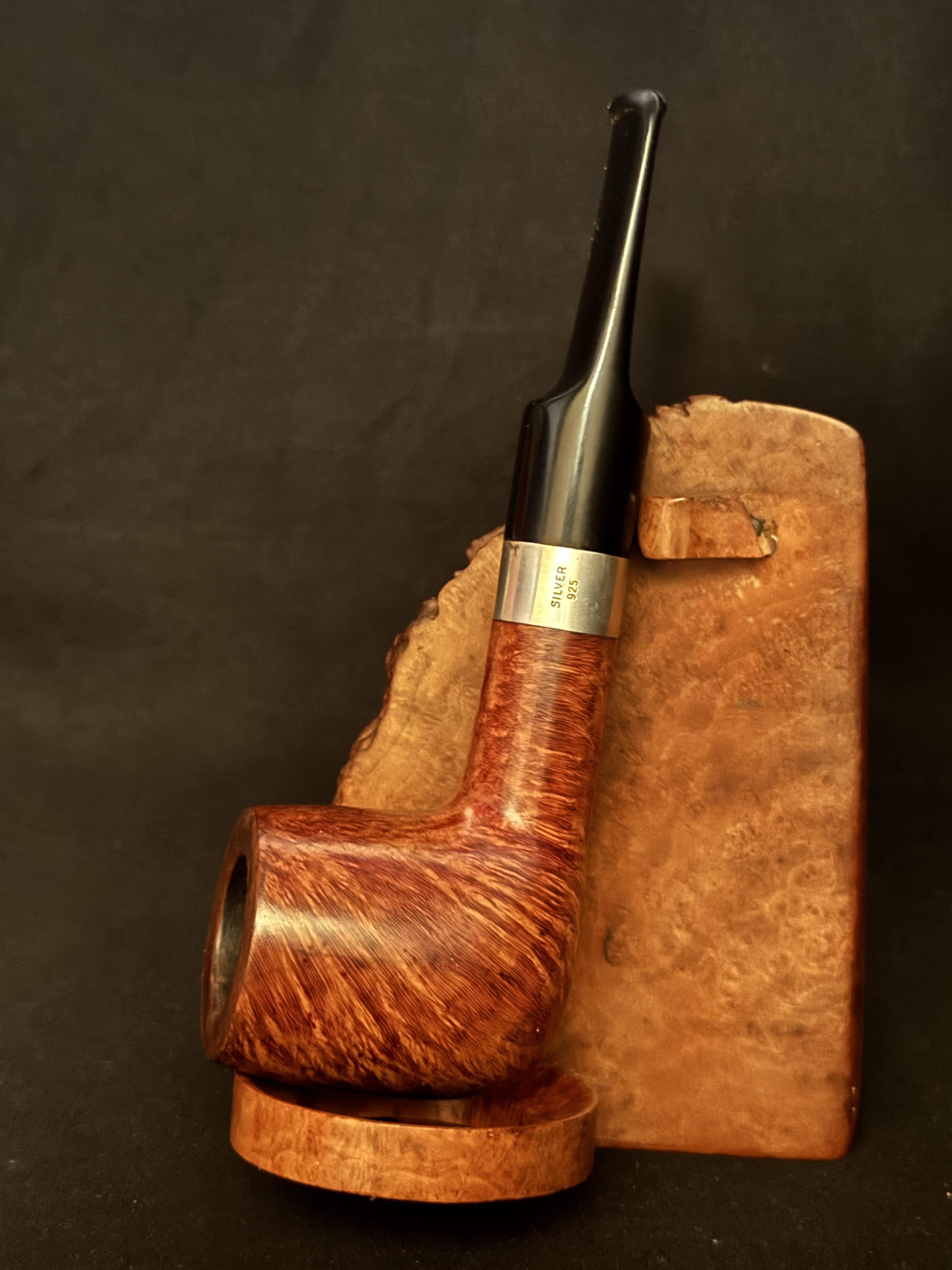
Sterling Silver Band Billiard Estate Pipe, Vulcanite Stem, 9mm Filter
$79.00
Material
Briar
Availability
Only 1 left
Tags
billiard pipeestate pipevulcanite stemsilver bandDanish pipebriar pipe9mm filtervintage pipesmoking pipepipe collectorfishtail stemsmooth finishcross grain
1
Carefully Packaged
Authenticity Guaranteed
Free shipping over $150
About this Piece
Welcome to Pipe Collectors Encyclopedia, your premier destination for museum-quality estate pipes with comprehensive historical and technical documentation.
IDENTIFICATION
This is an unmarked billiard of exceptional briar quality and finish work. The pipe bears a sterling silver 925 band as its sole maker's mark. The bowl and shank are finished in a smooth, polished vulcanite cut-a treatment reserved for the finest briar pipes, particularly those produced by Danish and Northern European makers of the mid-to-later twentieth century. The stem is vulcanite saddle type with a fishtail mouthpiece and 9mm filter accommodation. This is the sort of piece that circulates among estate lots without attribution, yet the grain quality and construction discipline point to a house of considerable reputation.
HISTORICAL CONTEXT
The billiard remains one of the most enduring shapes in pipe design, a straight-stemmed, cylindrical bowl with modest shoulder, first codified in the early twentieth century and adopted as a foundational model by virtually every established maker. The shape's simplicity conceals its demand: a true billiard requires flawless briar selection and turning work, because the geometry offers no visual rescue for poor grain orientation or tool marks.
The vulcanite cut finish-a labor-intensive hand or machine polishing of the briar surface to a high gloss-signals both the maker's confidence in the briar's quality and the intended market tier. This finish was standard among premium Danish makers of the postwar era and remains a hallmark of Scandinavian pipe craft. The finish resists oxidation, shows grain at full depth, and ages with remarkable stability, which explains why estate pipes in vulcanite cut often appear nearly unworn despite decades of storage.
The sterling silver band is functional as well as decorative. Beyond its role as maker's mark or house insignia, the band reinforces the shank junction, a structural point that can be prone to checking in pipes subjected to thermal stress or humidity swing. The use of sterling (hallmarked 925) rather than plate or alloy speaks to the maker's material commitment and implies a house with sufficient volume and reputation to justify precious-metal accents.
Billiards of this quality were produced in quantity by the leading Northern European workshops throughout the 1950s, 1960s, and 1970s. Without further attribution marks, this pipe sits in that broad middle register of premium estate stock-not a marked collector's piece, but unmistakably a house product, not a rough-turned commodity pipe.
GRADING AND MARKS
- Sterling silver 925 band: maker's mark or house band; the sole stamp on the pipe.
- No other maker's mark, country-of-origin stamp, or grade indicator is present.
- The band does not carry a hallmark punch or assay date letter.
The absence of secondary marks-country mark, shape number, or grade dot-is typical of pipes from certain Scandinavian makers who relied on the silver band and the pipe's own finish as sufficient attestation of quality. The band's presence confirms the maker's deliberate choice to mark the piece in precious metal rather than in printed or stamped nomenclature on the shank.
SHAPE ANALYSIS
This is a classic straight billiard: cylindrical bowl with gentle shoulder, straight shank of equal diameter to the bowl, and balanced proportions throughout. The bowl stands at 45mm in height against a 35mm width, yielding a height-to-width ratio of approximately 1.3:1-within the traditional billiard envelope.
The cross-grain and bird's-eye figuring visible in the briar is the dominant visual feature. Grain orientation of this type-vertical and cross-running patterns-occurs when the briar block is cut and turned such that the growth rings present themselves at varied angles to the eye. Bird's-eye, the small circular patterns, results from medullary ray exposure and is considered desirable in European briar selections, particularly Calabrian and Algerian cuts. This figuring is often most pronounced in billiards, where the cylindrical turning emphasizes axial grain run.
The vulcanite saddle stem with fishtail mouthpiece is standard accommodation for a pipe of this caliber. The stem rests in the hand with the flat fishtail edge forward, presenting a tactile and ergonomic grip. The 9mm filter system indicates mid-to-late twentieth-century manufacture, as this standard became widespread after the 1950s.
BRIAR AND FINISH
The briar is of high grade, evidenced by the clarity and definition of the grain pattern and the absence of fill work or plugging in the visible areas. The cross-grain and bird's-eye figuring indicates careful selection of the briar block and precise turning to expose these features at maximum visibility.
The vulcanite cut finish is a polished surface treatment that brings the briar's natural color and figure into sharp relief. Unlike a stained or colored finish, which can mask mediocre briar, the vulcanite cut demands excellent wood quality to be visually successful. The finish is achieved through mechanical polishing-typically sanding progressively through fine grits, then buffing to a mirror-like sheen. This method exposes the full depth of color variation in the briar and emphasizes grain and medullary ray definition.
Under light, the finish reveals consistent luster across the bowl and shank, with no dulling or loss of polish save where age and use have modified the surface. The color is a warm brown with darker variegation following the grain, characteristic of naturally aged briar exposed to ambient light and controlled humidity for decades.
The vulcanite cut finish is notably stable over time. Unlike lacquer or varnish, which can yellow, crack, or become sticky, the polished vulcanite surface hardens and settles into a stable patina. This accounts for the pipe's pre-smoked but well-preserved appearance despite evident age.
CONDITION REPORT
The pipe is in very good overall condition, consistent with careful use and proper storage.
Rim: Darkening visible on the rim surface, consistent with normal charring from use. No significant burn-back or damage to the bowl edge.
Bowl and briar: The finish shows light scratches and faint staining distributed across the briar surface. No major fills, plugs, or repairs are evident. Tiny dents are present on the briar, minor surface disturbances without structural consequence.
Stem and mouthpiece: The vulcanite stem shows very tiny dents on the fishtail mouthpiece, consistent with light chewing or contact wear. No cracks, splits, or oxidation is reported.
Chamber: Pre-smoked; no obstruction or damage noted.
Structural integrity: The silver band is secure and shows no lifting, loosening, or damage. The shank-to-bowl junction is sound.
Overall: This pipe has been smoked and handled but not abused. The condition is consistent with estate stock from a careful owner. The finish and grain remain fully legible and visually intact.
DIMENSIONS
- Overall length: 133mm (5.3 inches)
- Bowl height: 45mm (1.8 inches)
- Bowl width: 35mm (1.4 inches)
- Bowl depth: 40mm (1.6 inches)
- Chamber diameter: 20mm (0.8 inches)
- Weight: 1.55 oz
- Filter: 9mm
CLOSING
Ships from the Faridunhill / Pipe Collectors Encyclopedia archive. Worldwide shipping and professional sanitation on every estate pipe.
SKU: SKU-055