Loading
Estate Pipes
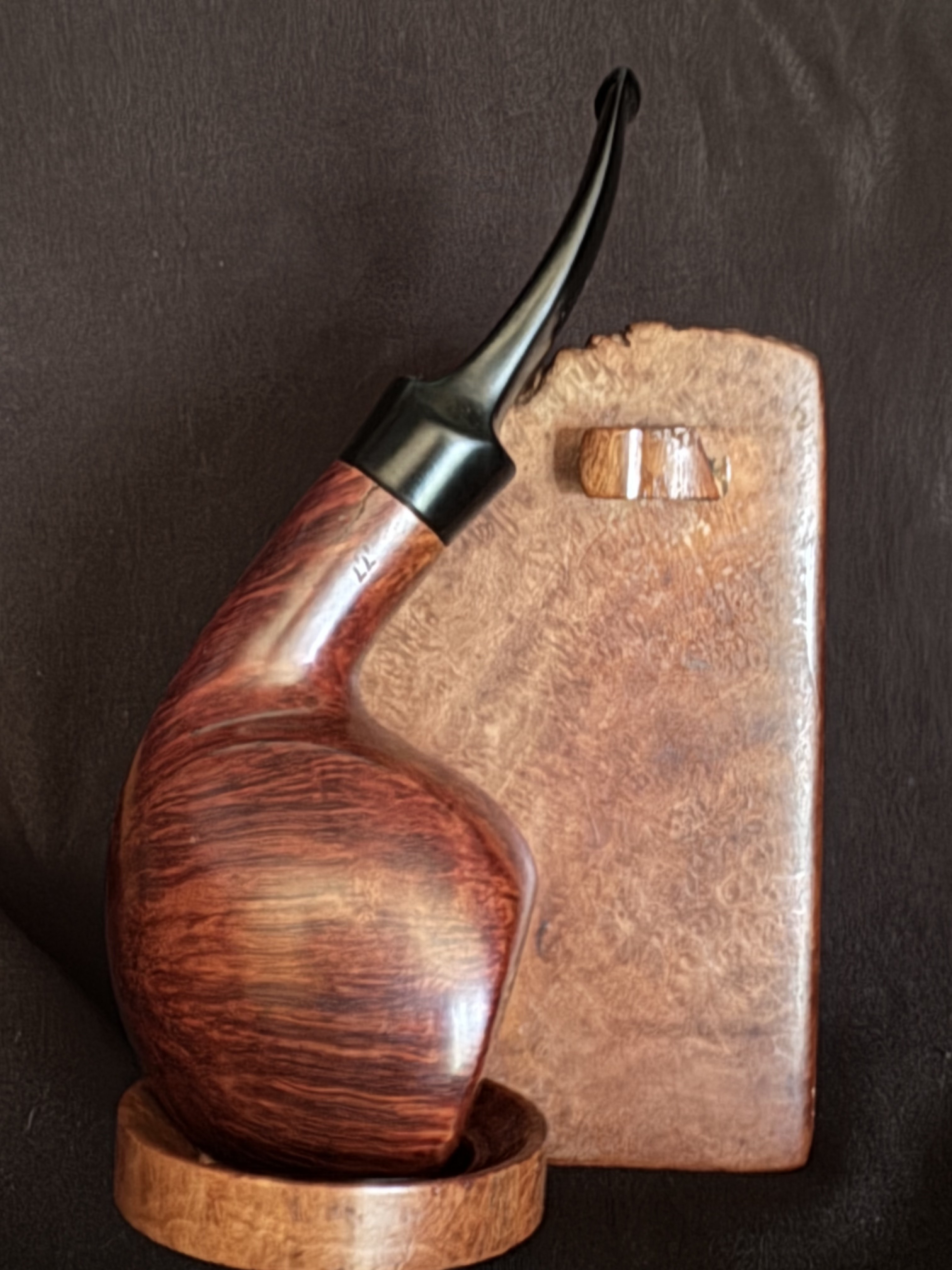
Stanwell Royal Briar Shape 77 Freehand Estate Pipe - Sixten Ivarsson Design, Danish Briar, Vulcanite
$225.00
Not every Stanwell block earned this name.
Material
Briar
Availability
Sold
Tags
StanwellPipeRoyalRougeShape77FreehandSixtenIvarssonDanishPipeEstatePipeFlameGrainVulcanite9mmFilterBriarPipeSoftTriangleCollectorPipe
This piece has been sold and is no longer available.
Carefully Packaged
Authenticity Guaranteed
Free shipping over $150
About this Piece
Not every Stanwell block earned this name. Royal Briar marked the ones judged good enough to skip the stain most Danish shops relied on to even out lesser figure, and this shank still carries that designation stamped plain, next to a shape number that names its own geometry: 77.
Two names belong on this pipe: Stanwell, who cut and stamped it, and Ivarsson, whose hand is behind the shape it was cut to.
Stanwell traces to 1942, when Poul Nielsen began making pipes under the Kyringe name, working in beech through wartime shortages in materials. The Stanwell trademark itself was registered in 1948, filed as Reg. No. 969-48, alongside the horse-drawn-carriage mark that went on boxes and silverwork. The crowned-S logo on the stem followed that registration; in the years right after 1948 it appeared only on the house's top lines, not the full catalogue. Sixten Ivarsson, who died in 2001, began as a repairman at Suhr's workshop in Copenhagen during the 1940s before becoming, around 1950, Denmark's first independent pipe artisan.
The shank carries three legible stampings, plus the shape number.
THE MARKS
- Crown stamp (Stanwell factory mark), crisp and legible
- Stanwell name stamped
- Royal Briar grade designation stamped
- Shape number 77 stamped on the shank
Stanwell catalogued this one as shape 77, and the trade nickname for it is the soft triangle: three organic lobes in plan view, sidewalls bowed rather than flat, the bowl rising into the shank without a hard seam anywhere along the transition. The chamber sits centered inside that irregular exterior, which is the harder half of carving a freehand: the outside can wander, the inside cannot. The stem is a saddle mount in vulcanite, a stepped-down mortise rather than a tapered one, reading as a small ledge where stem meets shank instead of a smooth flow-through. Held in the hand it reads as much as sculpture as smoking instrument, meant to be turned and looked at from more than one angle.
The Royal Briar finish on this example shows vertical flame grain running through the bowl and continuing into the shank, with a golden-honey cast to the wood consistent with choice Mediterranean briar. Flame grain runs in a straight, tight line up the block rather than swirling into birdseye, and a carver only gets it by cutting along the grain's own direction rather than against it. Grades like Royal Briar exist because that kind of figure shows in only a fraction of the briar coming off a curing rack; most blocks get a stain dark enough to even out lesser grain, and the ones that do not need it get set aside for a line like this. Under raking light the flame here still reads bold rather than faded.
Condition: excellent, unrestored, original. A stable crack, roughly 8 to 9 mm, runs across the underside of the shank, consistent with long-term dry storage. It does not reach the chamber and does not affect the draft. It is not visible when the pipe sits in normal display position. No fills, no repairs, no refinishing detected. The stem is vulcanite, saddle cut, and shows no oxidation.
THE MEASUREMENTS
- Length: 145 mm
- Bowl height: 52 mm
- Chamber diameter: 20 mm
- Chamber depth: 42 mm
- Weight: 48 g
- Filter: 9 mm
Ships from the Faridunhill / Pipe Collectors Encyclopedia archive. Worldwide shipping and professional sanitation on every estate pipe.
SKU: SKU-026