Loading
Estate Pipes
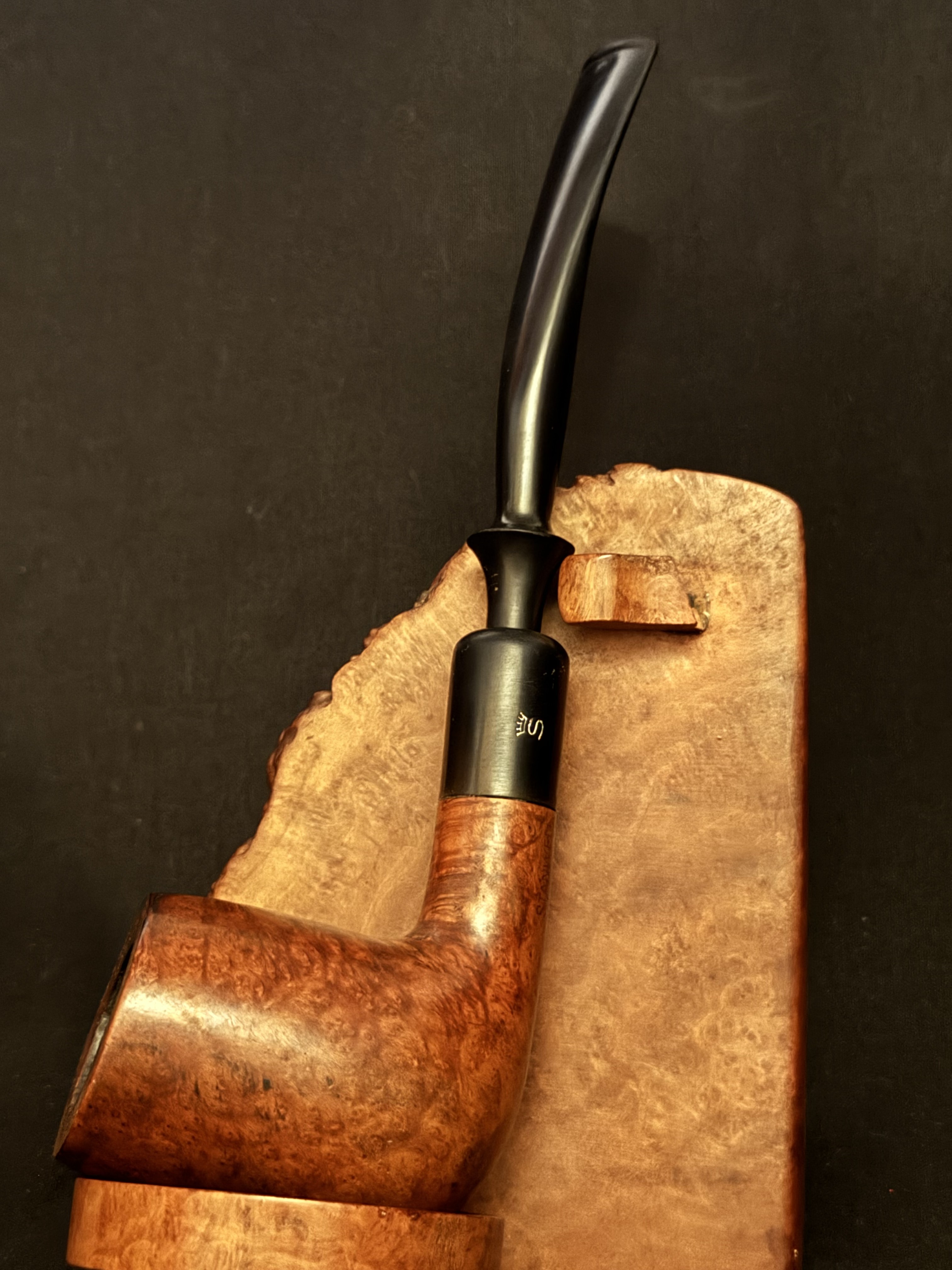
Stanwell Hand Made Reg 969-48 Smooth Billiard Army Mount Estate Pipe, 1950-1985
$350.00
Material
Briar
Availability
Only 1 left
Tags
Stanwell pipebilliard shapeDanish pipeestate pipevintage 1950ssmooth briarvulcanite stemhand madearmy mountcollector pipemid-centurytobacco pipereg 969-48
1
Carefully Packaged
Authenticity Guaranteed
Free shipping over $150
About this Piece
Welcome to Pipe Collectors Encyclopedia, your premier destination for museum-quality estate pipes with comprehensive historical and technical documentation.
IDENTIFICATION
This is a Stanwell Hand Made registered pipe, model 969-48, in smooth finish. The pipe is a straight billiard with an army mount configuration, featuring a pencil vulcanite stem and vulcanite insert on the shank. It dates to the 1950-1985 production window based on the shape design and COM stamp. The registration number 969-48 ties this pipe to Stanwell's mid-century Danish production era, when the brand was establishing its reputation for hand-selected briar and consistent craftsmanship.
HISTORICAL CONTEXT
Stanwell was founded in 1946 in Copenhagen, Denmark, by Poul Rasmussen and Erik Nrding. The brand emerged in the immediate postwar years when European pipe manufacturing was recovering, and it quickly distinguished itself through rigorous briar selection and hand-finishing techniques. By the 1950s, Stanwell had become known among collectors for pipes that balanced accessibility with quality-they were not luxury pipes in the Dunhill or Peterson tier, but they were thoughtfully made, with good briar and honest construction that rewarded the working smoker.
The registration system used on Stanwell pipes (the "Regd No." stamp) was part of a cataloging approach that allowed the factory to track shape lineage and production batches. Shape 35, which appears in the archive as a visual match for this pipe, was designed by Sixten Ivarsson and Anne Julie during the early 1950s and remained in production for several decades. The billiard remains one of the most enduring shapes in pipe history-it offers a generous bowl, a straight profile that suits both hand and pocket, and a visual clarity that allows the briar figure to dominate.
Stanwell's hand-made pipes from this era are prized by collectors who value Danish craftsmanship without the premium pricing of the luxury market. The brand sits in a sweet spot: better finish and briar selection than mass-produced British or Italian pipes of the same decade, but more affordable and less fussy than the Swiss or high-end British competitors. Pipes from this registration and era are steady performers in the estate market.
GRADING AND MARKS
* "STANWELL" + "HAND MADE" + "REGD NO 969-48" + "MADE IN DENMARK" - stamped on the shank. These marks identify the maker, production method, registered model number, and country of origin. The registration number is the key to dating and cataloging.
* "S" with crown logo - appears on the shank. This is a Stanwell maker's mark, used during the mid-century production run.
* "42 L" - appears in stamps, likely a size or batch code.
* No COM or quality grade stamp visible in the note (absent, not recorded). Some Stanwell pipes carried grade marks (AA, A, B); the lack of an explicit grade notation is not unusual for hand-made pipes of this period.
The stamp configuration and the "Hand Made" designation confirm that this pipe received individual finishing work rather than being part of a purely automated production line. By the 1950s-70s, "hand made" on a Stanwell typically meant hand-selected briar, hand-drilled chambers, and hand-finished surfaces-not that every step was manual.
SHAPE ANALYSIS
This is a straight billiard-one of the oldest and most stable pipe shapes, defined by a cylindrical or slightly tapered bowl sitting upright on a straight shank. The billiard's geometry makes it equally at home cradled in the hand or held upright in the mouth, and it presents the grain of the briar without the visual distraction of curves. The army mount configuration (metal ferrule and stem assembly) was particularly popular in Scandinavian and British pipes of the mid-twentieth century; it allows for easy stem replacement and gives the pipe a formal, utilitarian edge.
The pencil vulcanite stem indicates a relatively slender mouthpiece, suited to the mouth-held position rather than a deep grip. The vulcanite insert on the shank is a durability feature, protecting the wood from moisture and wear where the stem meets the briar. This is honest construction: the insert is functional rather than decorative. At 155mm overall length and with a bowl height of 47mm, this billiard sits in the middle range-substantial enough for a full bowl, compact enough for pocket carry or travel.
BRIAR AND FINISH
The smooth finish indicates that the briar was turned and sanded to a polished surface, with no carved or rusticated texture. Smooth finishes demand better-quality briar, because every grain inclusion, small crack, or fill becomes visible. Stanwell's selection criteria during this era emphasized dense Mediterranean or North African briar blocks-the kind that machines well and develops an even patina over time.
Under a smooth finish, the briar's character emerges gradually. New smooth pipes often look slightly plastic; after a few years of handling and light smoking, the finish develops micro-scratches that catch the light, and the grain becomes warmer and more visible. The finish is achieved by sanding progressively finer and then either waxing or sealing with a light nitrocellulose lacquer-Stanwell's approach during this period was typically the latter.
The color in the note is described as brown (the natural briar tone), which is consistent with period Stanwell documentation. Smooth finishes in this era were not dyed to vivid reds or blacks; they were left close to the briar's natural tone, allowing the figure and grain to be the primary visual element.
CONDITION REPORT
Overall grade: very good, with evidence of pre-smoking and use.
The pipe has been smoked in and shows patina consistent with light to moderate use over decades. The rim displays darkening-a common mark where tobacco ash and heat have oxidized the surface briar. This is wear consistent with normal use, not damage.
Bite marks are present on the mouthpiece. These are shallow tooth impressions in the vulcanite stem, typical of pipes that have been held clenched. They do not affect function or structural integrity; they are a record of use.
No repairs, fills, cracks, or stem replacements are noted. The vulcanite insert on the shank appears intact. The stem is the original pencil vulcanite, not a replacement.
The no-filter fishtail mouthpiece opening is clean and unobstructed.
Weight is 1.4 oz, consistent with a mid-sized billiard of this briar density.
DIMENSIONS
* Overall length: 155mm / 6.2 inches
* Bowl height: 47mm / 1.9 inches
* Bowl width (diameter): 35mm / 1.4 inches
* Bowl depth: 40mm / 1.6 inches
* Chamber diameter: 20mm / 0.8 inches
* Weight: 1.4 oz
CLOSING
Ships from the Faridunhill / Pipe Collectors Encyclopedia archive. Worldwide shipping and professional sanitation on every estate pipe.
SKU: SKU-122