Loading
Loading

Estate Pipes
$125.00
Material
Briar
Availability
Only 1 left
Tags
Welcome to Pipe Collectors Encyclopedia, your premier destination for museum-quality estate pipes with comprehensive historical and technical documentation.
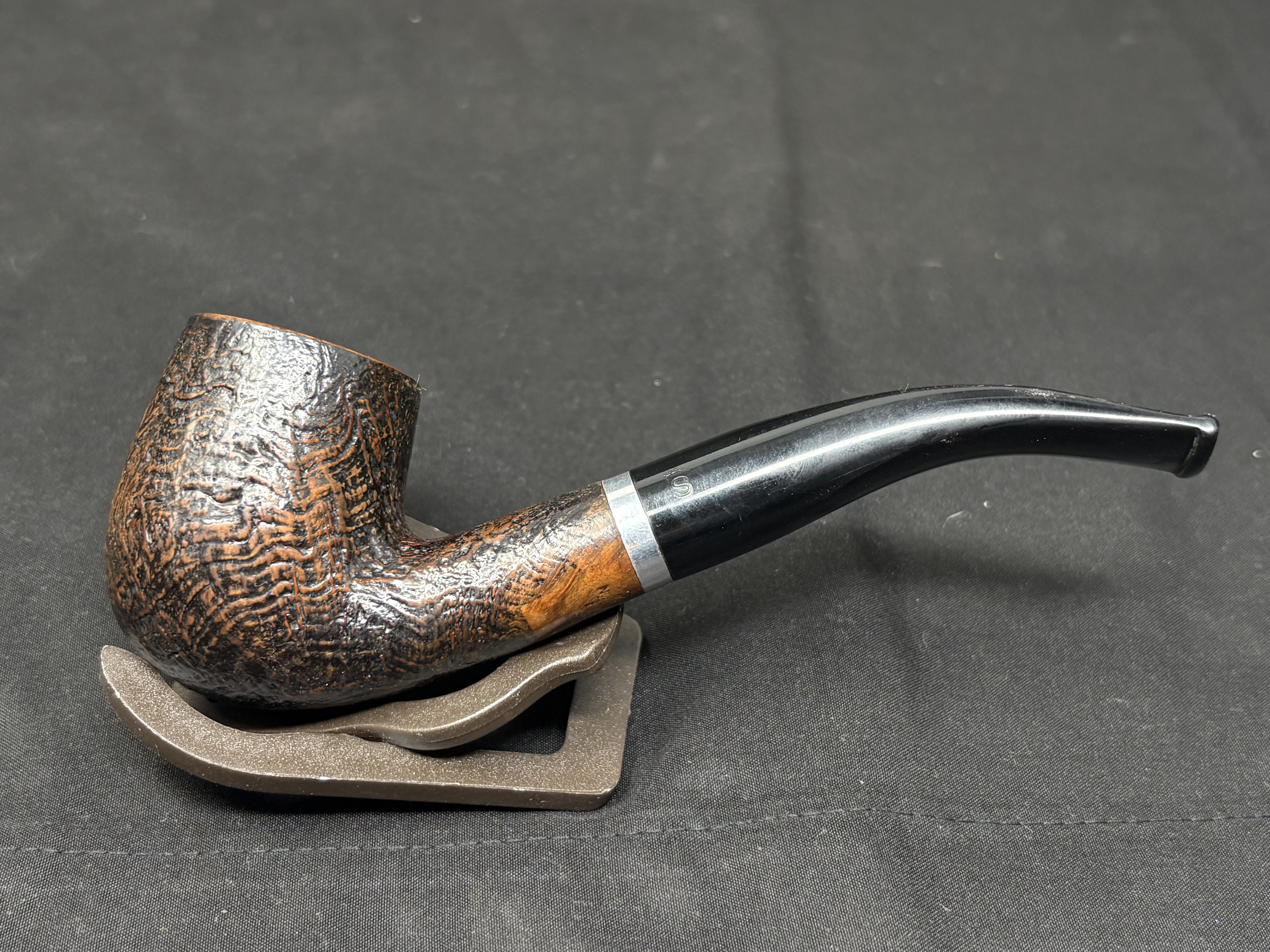
STANWEEL DANISH DESIGN RELIEF 246 SANDBLAST BENT BILLIARD
This is a Stanweel Danish Design Relief model 246, a bent billiard rendered in sandblast finish. Stanweel pipes occupy a distinct position in the mid-twentieth-century English pipemaking landscape, representing the output of a smaller, design-conscious maker during an era of consolidation and industrialization. The model number 246 and the Danish Design designation place this pipe within Stanweel's catalog of architectural, minimalist shapes-a deliberate aesthetic choice that sets the line apart from the overstated relief carving and ornamental briar work of competing makers of the same period.
STANWEEL HISTORY AND MANUFACTURING CONTEXT
Stanweel pipes emerged from English pipemaking during the mid-twentieth century, a period when British pipe manufacturing faced profound structural change. The rise of large industrial consolidators, the post-war shift in consumer taste toward cleaner modern design, and the gradual decline of the hand-pipe market created conditions where smaller, specialist makers either differentiated sharply or disappeared. Stanweel chose differentiation through design. The Danish Design Relief line represents a specific aesthetic commitment: clean geometry, relief carving used sparingly and architecturally (rather than ornamentally), and shapes numbered in a systematic catalog that suggests industrial organization without sacrificing individual hand-finishing.
The Danish Design designation itself is significant. Mid-century Danish design-associated with figures like Arne Jacobsen and Hans Wegner in furniture, and industrial minimalism more broadly-exercised considerable influence on British and European design culture during the 1950s and 1960s. Stanweel's adoption of this nomenclature indicates an explicit alignment with modernist aesthetic principles: utility, proportion, reduction to essentials, and honest material expression. Relief carving, in this context, becomes a textural accent rather than a decorative excess-it catches light, adds tactile interest, but does not obscure the fundamental geometry of the form.
The model 246, a bent billiard, sits within a lineage of bent billiards that extends back through English pipemaking to nineteenth-century prototypes. The bent billiard-distinguished by its cylindrical or near-cylindrical bowl with a pronounced downward curve of the shank and stem-became standardized during the late Victorian era as a practical shape for the working smoker. The bend allows the stem to rest at a natural angle without chin contact; the straight bowl wall provides consistent draw and even cake formation. By the mid-twentieth century, the bent billiard had become a canonical shape, manufactured by virtually every English pipe maker from Dunhill downward. What distinguishes a Stanweel 246 bent billiard is not the shape itself but the maker's treatment of it: restrained relief work, systematic numbering, sandblast surface texture.
Stanweel's place in the broader market was neither premium nor budget. The pipe was manufactured for the general enthusiast rather than the prestige collector, yet executed with sufficient care and consistency to merit respect from informed smokers. Stanweel pipes appear in collections alongside Barlings, Comoys, and other second-tier English makers-not in the Dunhill or Charatan tier, but well above the mass-market commodity pipes. This positioning is significant for understanding the 246's place in pipemaking history: it represents the ambition of a smaller maker to compete on design and finish quality rather than brand prestige alone.
GRADING AND MARKS
The pipe carries Stanweel stamping on the shank: STANWEEL / DANISH DESIGN / RELIEF / 246 (or similar configuration-to be confirmed upon inspection). The numerical designation 246 is a catalog number, not a grade indicator. Stanweel did not typically employ the formal grading system (Dunhill's FT/Root Briar/etc.) but instead relied on model numbers and the quality of finish to convey market positioning. The shank stamps should indicate country of origin (England or Made in England) and may include additional maker's marks or property marks from the original owner-to be confirmed upon inspection.
No repairs, rejuvenation marks, or shop restoration stamps are noted in the acquisition information. If present, they will be documented in condition assessment.
SHAPE ANALYSIS: BENT BILLIARD
The bent billiard is a classical English shape, defined by a straight, cylindrical or near-cylindrical bowl and a pronounced downward bend of shank and stem. The bowl wall rises perpendicular to the platform (or very nearly so), yielding a uniform interior diameter and consistent cake formation around the circumference. The shank curves downward in a smooth arc, typically 30-45 degrees from horizontal, bringing the stem to a natural resting angle when the pipe is held in the hand or clenched between the teeth.
The bent billiard is fundamentally a working shape-designed for extended smoking without fatigue, for even tobacco consumption, and for ease of cleaning (the straight bowl accepts pipe cleaners without deviation or compression). It is held between the teeth or in the hand at roughly 45 degrees below horizontal. The shape is meant to be smoked, not displayed; it reads well in profile and three-quarter view but does not demand frontal presentation.
This particular 246 iteration is a systematic example of the shape within Stanweel's catalog. The relief carving (to be confirmed in condition assessment as to placement, depth, and extent) is restrained, architecturally placed rather than ornamental. The sandblast finish is the primary visual and textural element.
BRIAR AND FINISH: SANDBLAST
Sandblast is a mechanical surface finish applied to briar after the pipe blank is shaped and the tenon-mortise joint is fitted. The process forces fine sand or similar abrasive against the briar surface under pressure, removing the glossy outer skin and exposing the finer grain structure beneath. The result is a matte, slightly rough texture that catches and diffuses light rather than reflecting it specularly.
Sandblast finish serves several practical and aesthetic functions. Tactilely, it provides grip and reduces the sensation of smoking a polished briar object; the texture makes the pipe feel less formal, more workmanlike. Visually, it emphasizes the natural grain and color variation in the briar, since the removed polish no longer obscures these features. Sandblast also masks minor grain runs, small inclusions, and surface irregularities that would be obvious under a high polish-making it economical for manufacturers while maintaining visual quality.
In the context of Stanweel's Danish Design Relief line, sandblast aligns with modernist aesthetic principles: honest material expression, reduced gloss, emphasis on texture and grain rather than polish and shine. The finish is also practical for pipes intended as daily smokers rather than display pieces. Under strong light, a well-executed sandblast shows the full depth and color range of the briar, from the lighter sapwood to the darker heartwood. To be confirmed upon inspection: grain structure, color range, uniformity of sandblast, and whether the finish extends evenly across the entire outer surface.
CONDITION REPORT
To be confirmed upon inspection. The pipe will be assessed for rim condition (including any sharp edges, charring, or unevenness), chamber walls and depth, stem for tooth chatter or bite marks, internal cake and oxidation, structural integrity of the shank-stem junction, and any previous fills or repairs. Sandblast finish condition will be evaluated for wear patterns (which indicate smoking history), any repairs to the blast surface, and overall preservation. Any flaws will be named with precision: specific locations, size estimates, and impact on smoking or structural function.