Loading
Estate Pipes
Oldenkott TOWER Smooth Bent Brandy Estate Pipe - Vulcanite Saddle Stem, 9mm Filter
$75.00
Smooth bent - that is the phrase the seller read straight off this pipe as he held it, and it is the truest way to describe what you are looking at: an Oldenkott stamped TOWER on t
Material
Briar
Availability
Only 1 left
Tags
OldenkottTower PipeEstate PipeBriar PipeBent BrandyVulcanite StemGerman PipeSmooth BriarVintage Pipe9mm FilterPipe CollectorFishtail StemEstate Briar
1
Carefully Packaged
Authenticity Guaranteed
Free shipping over $150
About this Piece
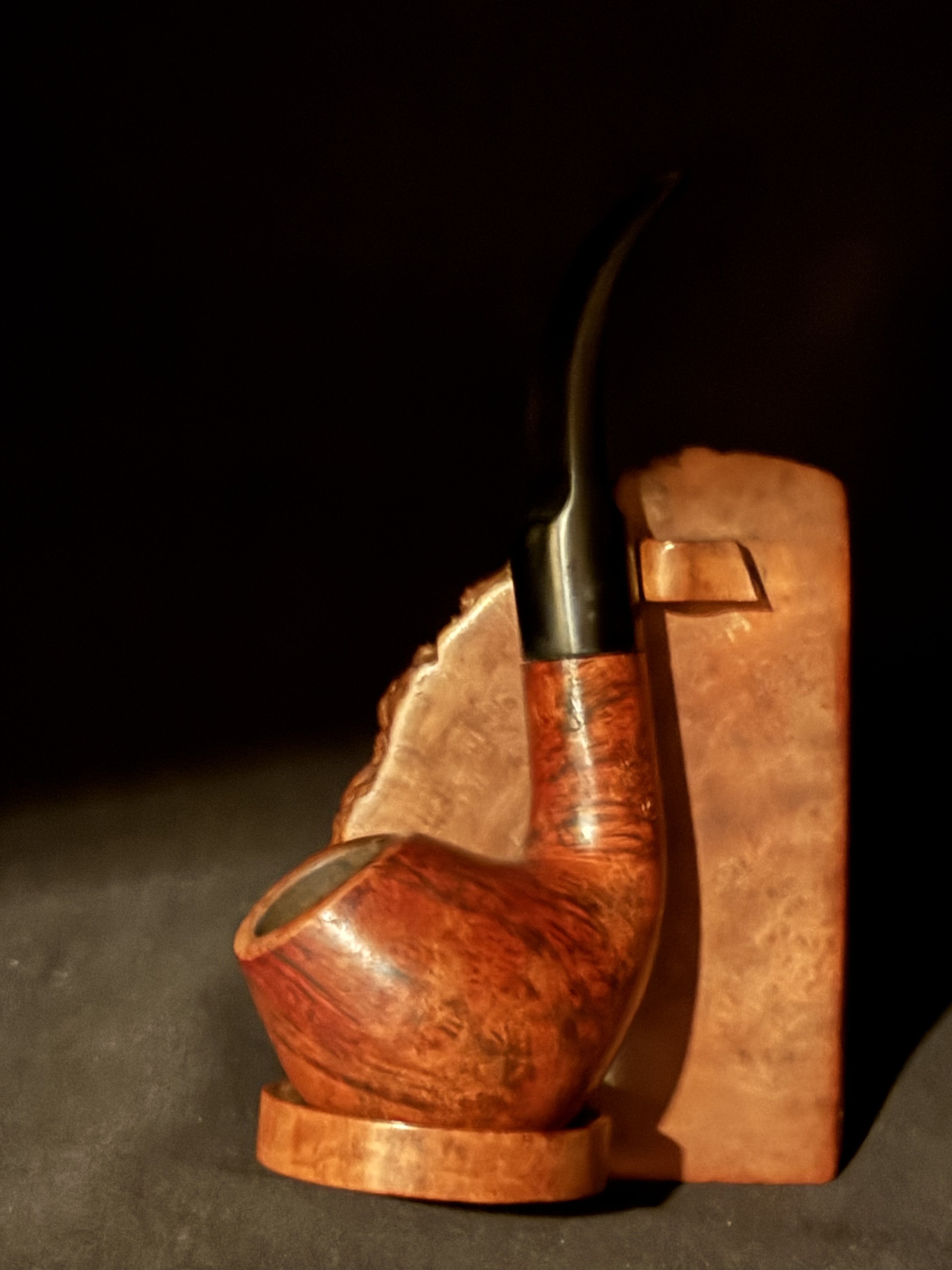
Smooth bent - that is the phrase the seller read straight off this pipe as he held it, and it is the truest way to describe what you are looking at: an Oldenkott stamped TOWER on the shank, in a smooth-finished bent brandy with cross grain and birdseye showing in the briar.
This is a bent brandy shape in smooth briar, stamped OLDENKOTT TOWER on the shank, fitted with a vulcanite saddle stem cut to a fishtail slot and bored for a 9mm filter.
The Oldenkott name predates its pipes by more than a century and a half. The firm traces to two tobacco lines, Henricus Oldenkott of Rees and Hermannus Oldenkott of Ahaus, running back to the 1740s and 1760s, with an Amsterdam branch on record by 1918 under the name "Herms, Oldenkott und Zonen in Ahaus mit einem Zweiggeschaft in Amsterdam." In 1838 August Kersten of Rees bought the Heinric Oldenkott factories at Elten and Weesp, building what became one of Germany's largest tobacco houses of the nineteenth century.
Pipes came later, under a slightly different structure. "Original Oldenkott" pipes were advertised nationally out of Berlin in 1926. In 1929 the company bought the Ahaus and Neuss factories that had carried the Hermann-Oldenkott name, and German production of its own pipes began in 1932. By the postwar decades Oldenkott stood as Germany's second largest pipe manufacturer, behind only Vauen.
Niemeijer of the Netherlands acquired the company in 1972. Tobacco production stopped in 1974, and from that point the firm made pipes only. The Kersten family bought the pipe operation back in 1987; the factory closed in 1992. In 2012 the marks passed to Alexander Strahnz of Cologne, who revived the Oldenkott name with pipes made in Italy.
THE MARKS
- OLDENKOTT stamped on the shank
- TOWER stamped on the shank
A brandy shape takes its name from the rounded, short bowl that widens toward the rim the way a brandy snifter does, built to hold and show a broad face of briar rather than a tall column of it. On a bent example like this one the stem sweeps down and back toward the smoker's mouth, which shifts the pipe's balance toward the bowl and makes it a pipe better held in the hand or set in a rack than gripped by the teeth for long stretches. The vulcanite saddle stem steps down from the shank diameter to a slimmer bit, and the fishtail slot at the tip splits the airway into a wide, flattened opening that spreads the draw across the tongue rather than delivering it as a single jet, a cut commonly paired with bent shapes for exactly that reason.
The finish is smooth, and the seller notes cross grain and birdseye both visible on the bowl. Those are two faces of the same growth pattern, read differently depending on how the block was cut relative to the tree's rings: cross grain shows as the long flowing lines across the face of the bowl, while birdseye appears where the same rings are cut end-on, producing small round dots. Carrying both patterns cleanly on one stummel takes a well-chosen, well-quartered block, and a smooth finish leaves no stain or sandblast to mask a weak run of grain, so what shows under light is what the briar actually gave the cutter.
Condition: This is an estate pipe that has been smoked; it is not pre-smoked. The seller grades its overall condition as good for a vintage piece. Refer to the photographs for chamber cake, rim colour and stem oxidation.
THE MEASUREMENTS
Finish and grain: see the photographs for the cross grain and birdseye pattern described above.
Ships from the Faridunhill / Pipe Collectors Encyclopedia archive. Worldwide shipping and professional sanitation on every estate pipe.
SKU: SKU-409