Loading
Cigar & Smoking Accessories
Self-Regulating Moisture System (Vintage Desktop Specimen).SKU-340
$5.00
Self-Regulating Moisture System (Vintage Desktop Specimen).SKU-340
Material
Leather
Availability
In Stock
Tags
SKU-340SmoothstraightbilloardpipegermanestateamberstemBent
1
Carefully Packaged
Authenticity Guaranteed
Free shipping over $150
About this Piece
The Archival Humidor: A Collector’s Guide to the Self-Regulating Moisture System (Vintage Desktop Specimen)
Listing Description:
A Study in Precision: The Evolution of the Desktop Humidor
Step back into an era when the ritual of tobacco preparation was elevated to a science. Before the advent of digital hygrometers and electronic systems, the preservation of fine cigars relied on mechanical genius and the principles of physics. Offered here is a defining artifact of that bygone age: a precision-engineered desktop humidifier, designed as the silent guardian of a connoisseur’s collection. This is not merely a storage accessory; it is the mechanical heart of the classic humidor, a testament to the ingenuity of 20th-century design.
Historical Context & Provenance
The history of the humidor is a tapestry woven through the ages. While the great Irish woodworker Terence Manning is credited with crafting the first cabinet humidors in 1887 using exotic South African woods, the desire to control a cigar’s environment is far older . Before the rise of the luxury desktop box in the early 1900s, smokers relied on metal tins, ceramic jars, or even lead-lined furniture to combat the elements .
It was during the "Golden Age of Smoking" (roughly 1880-1930) that the humidor became a symbol of masculinity and refinement . As the 20th century progressed and the pursuit of the perfect draw intensified, the industry moved from passive storage to active humidification. The self-regulating black box you see here represents the pinnacle of that evolution—a move toward a "set it and forget it" mentality that allowed the collector to focus on the tobacco, not the maintenance.
Artifact Description & Materiality
Presented in its original packaging, this unit arrives to you in a "ready to use" state—a rarity for collectors who often acquire pieces with degraded or missing components.
· Dimensions: A compact and unobtrusive 3” x 3” x 0.75”, designed to integrate seamlessly beneath the existing tape or fitting of your humidor lid without disturbing the aesthetic of your antique case.
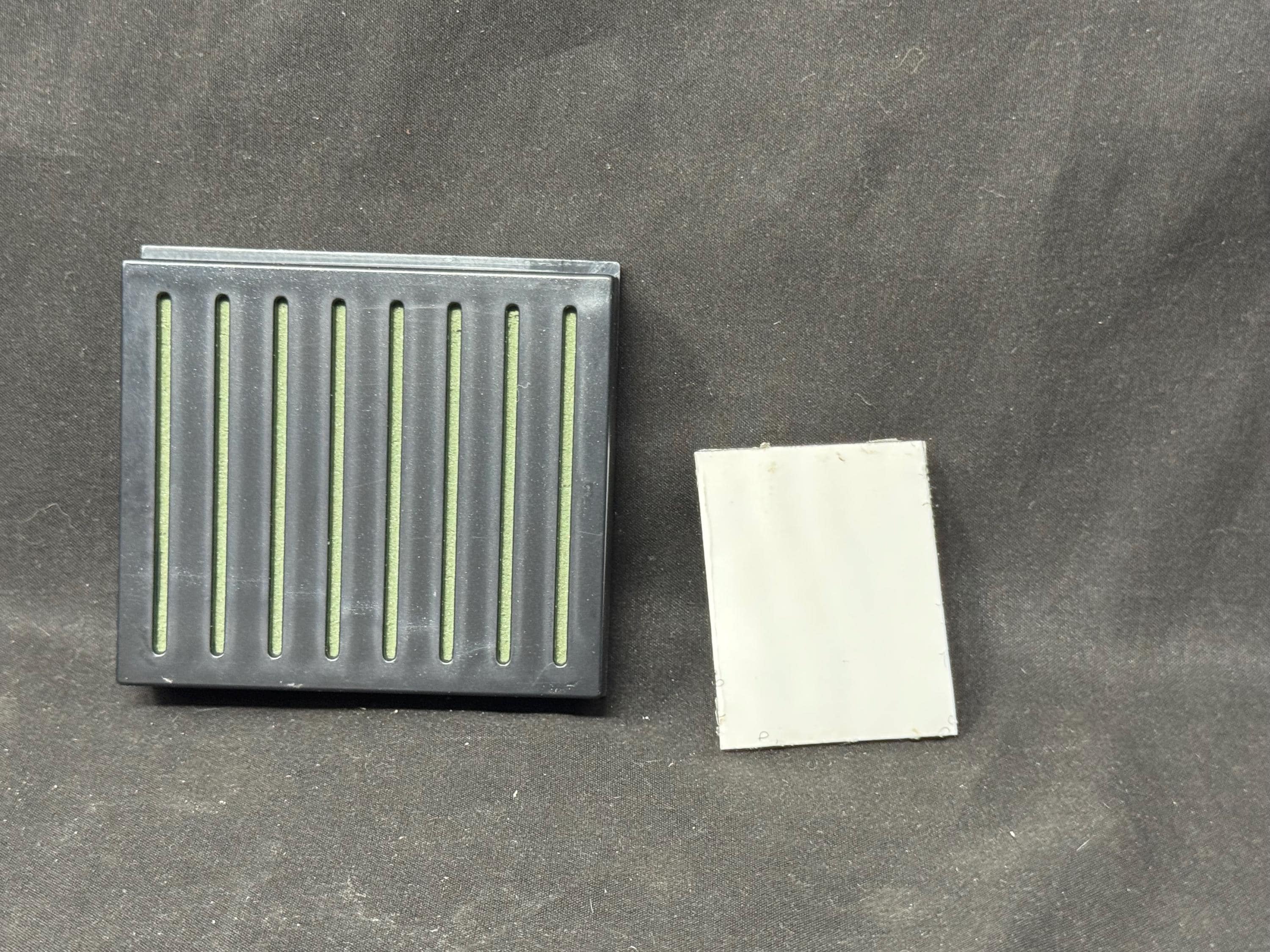
· Construction: The housing is a robust, period-correct black plastic box, favored by mid-century manufacturers for its impermeability and durability. Unlike wood, which can absorb and distort moisture levels, this synthetic housing ensures that every drop of water is directed exactly where it needs to go: into the atmosphere of your humidor.
· Mechanism: The unit utilizes a capillary saturation system. The included instructions, which reference the "back of the humidifier" and the visual cue of "overflow," indicate a sophisticated reservoir designed to hold a specific volume of water. This "self-regulating" design passively maintains the interior Relative Humidity (RH) without the need for chemical gels or sponges that can degrade over time .
Shape & Form: The "Concealed Workhorse" Aesthetic
Unlike the flamboyant Victorian humidors adorned with hunting scenes or the Art Deco masterpieces of Dunhill clad in burr walnut, this piece follows the "Machine Age" philosophy of functionalism . Its beauty lies in its utility.
In the taxonomy of collecting, this is known as the "Concealed Workhorse." It is the component that transforms a simple wooden cigar box into a true humidor. Collectors prize these original humidifiers because they are often the first thing to fail or get lost. Finding one still in its original packaging, with instructions, is akin to finding a vintage car with its original factory tools—it adds immense provenance and historical accuracy to a restoration project.
unlocking the authentic performance of your vintage humidor.
please check my other pipe list here:
https://www.ebay.com/sch/faridunhill/m.html?_nkw&_armrs=1&_ipg&_from
SKU: SKU-340