Loading
Estate Pipes
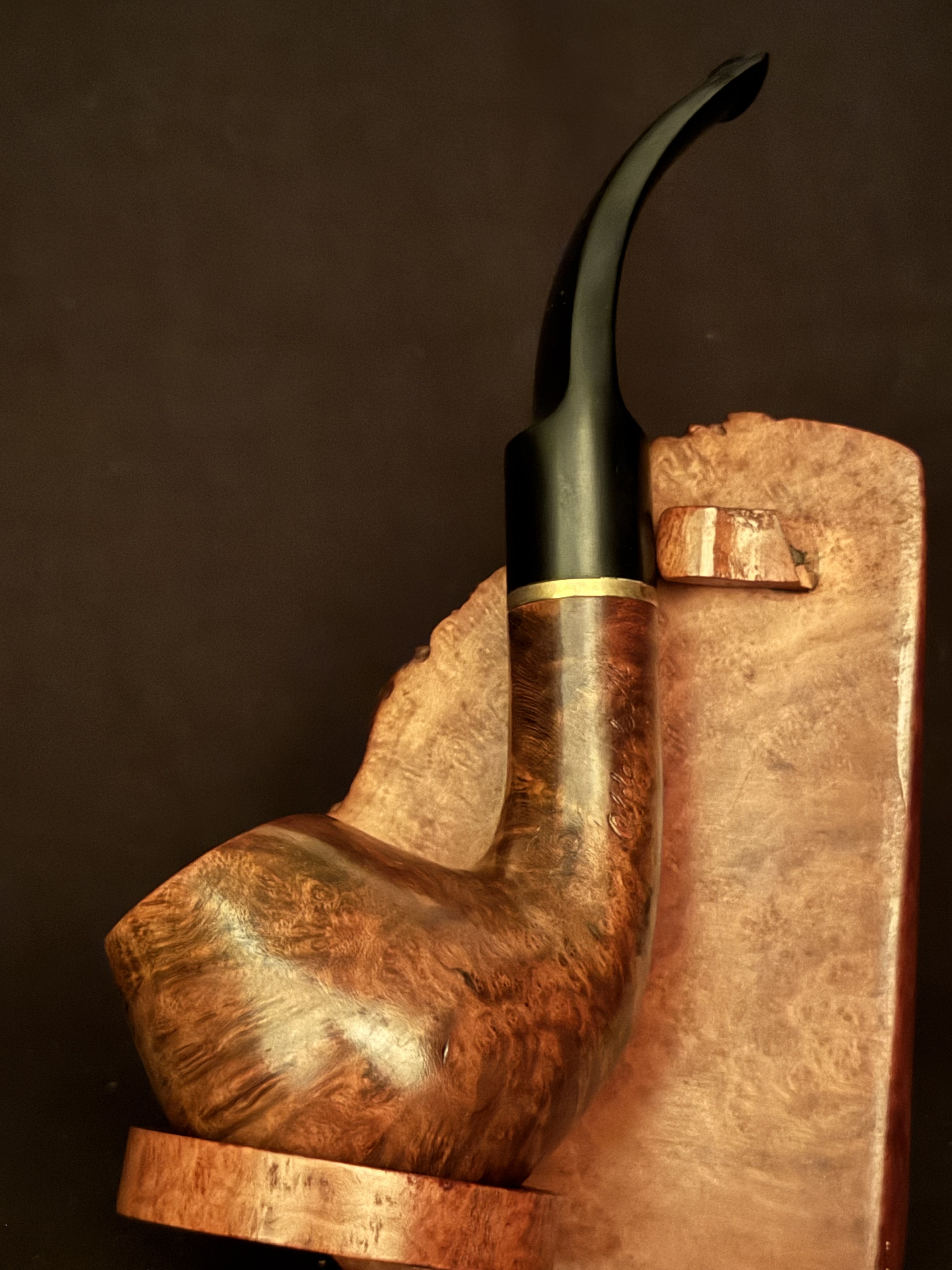
Oldenkott Smooth Bent Brandy Pipe - Vulcanite Saddle Stem, Brass Band, 9mm Filter - Estate
$80.00
The shank carries a single stamp: oldenkott, in lowercase, smooth against the briar, with no sub-brand or grade name beside it.
Material
Briar
Availability
Only 1 left
Tags
OldenkottEstate PipeBent BrandySmooth BriarVulcanite StemSaddle StemBrass Band9mm FilterFishtail BitGerman PipePipe CollectorVintage PipePre-Smoked Pipe
1
Carefully Packaged
Authenticity Guaranteed
Free shipping over $150
About this Piece
The shank carries a single stamp: oldenkott, in lowercase, smooth against the briar, with no sub-brand or grade name beside it. Plenty of Oldenkott pipes left the factory under a house name - Eminent, Excellent, Derby - so a plain factory stamp like this one is worth noting for what it does not say as much as what it does.
This is a bent brandy from Oldenkott, worked in a smooth finish, fitted with a vulcanite saddle stem and a brass band at the shank. The mouthpiece is cut fishtail at the button, and the bore is drilled to take a 9mm filter.
Oldenkott's roots run back further than most pipe firms still spoken of today. The name traces to two family lines in tobacco - Henricus Oldenkott of Rees and Hermannus Oldenkott of Ahaus - active from the 1740s and 1760s, with a branch house recorded in Amsterdam by 1918 as 'Herms, Oldenkott und Zonen in Ahaus mit einem Zweiggeschaft in Amsterdam.' In 1838 August Kersten of Rees bought the Heinric Oldenkott factories at Elten and Weesp, building what became one of Germany's largest tobacco houses; Oldenkott Knaster was smoked by Kruger during his exile, his likeness appearing on the tins by 1901. Pipes followed the tobacco. 'Original Oldenkott' pipes were advertised nationally out of Berlin in 1926, and after buying the Ahaus and Neuss Hermann-Oldenkott factories in 1929, the German company began making its own pipes in 1932. In the postwar decades Oldenkott ranked as Germany's second-largest pipe manufacturer, after Vauen. The Kersten family sold the pipe works to Niemeijer of the Netherlands in 1972; tobacco production ended in 1974 and pipes became the company's sole output. The Kerstens bought the pipe business back in 1987, and the factory closed in 1992. The marks were revived in 2012 by Alexander Strahnz of Cologne, with production moved to Italy and the bowls and shanks cut slimmer than the German originals.
THE MARKS
- oldenkott, stamped in lowercase on the shank - the plain factory mark, without a sub-brand or grade name attached
The brandy shape takes its name and its profile from the brandy snifter: a full, rounded bowl that widens toward the shoulder before drawing in to the shank, carried here on a bend that brings the stem down and back toward the jaw. It sits low and wide in the hand, and the round bowl gives it more presence on a rack than a slim billiard of the same weight would have. A bent shape also spreads the stress of clenching differently than a straight pipe: the bite falls closer to the button, and less leverage is transmitted back to the shank-stem joint. The saddle stem - stepped down in diameter from the shank rather than tapered flush into it - is the traditional cut for a pipe meant to be gripped firmly in the teeth, and the fishtail slot at the button opens the airway wider than a plain round bore, easing the draw. The brass band at the shank guards the briar at its narrowest and most vulnerable point.
The finish is smooth, as stamped and as described in the seller's note. Finish and grain: see the photographs for the briar's color and figure. A smooth finish is cut with no blasting or rustication: the briar is sanded through successively finer grits and buffed to a shine that lets the wood's own surface carry the pipe, rather than a textured finish doing the work. It is a finish with nowhere to hide a flaw, which is why briar chosen for smooth work is generally selected for clean grain to begin with.
Condition: pre-owned and smoked. The seller grades the pipe very good.
THE MEASUREMENTS
Length: 145mm / 5.8"
Bowl height: 48mm / 1.9"
Bowl width: 42mm / 1.7"
Chamber depth: 40mm / 1.6"
Chamber diameter: 20mm / 0.8"
Weight: 2.1 oz
Ships from the Faridunhill / Pipe Collectors Encyclopedia archive. Worldwide shipping and professional sanitation on every estate pipe.
SKU: 034