Loading
Estate Pipes
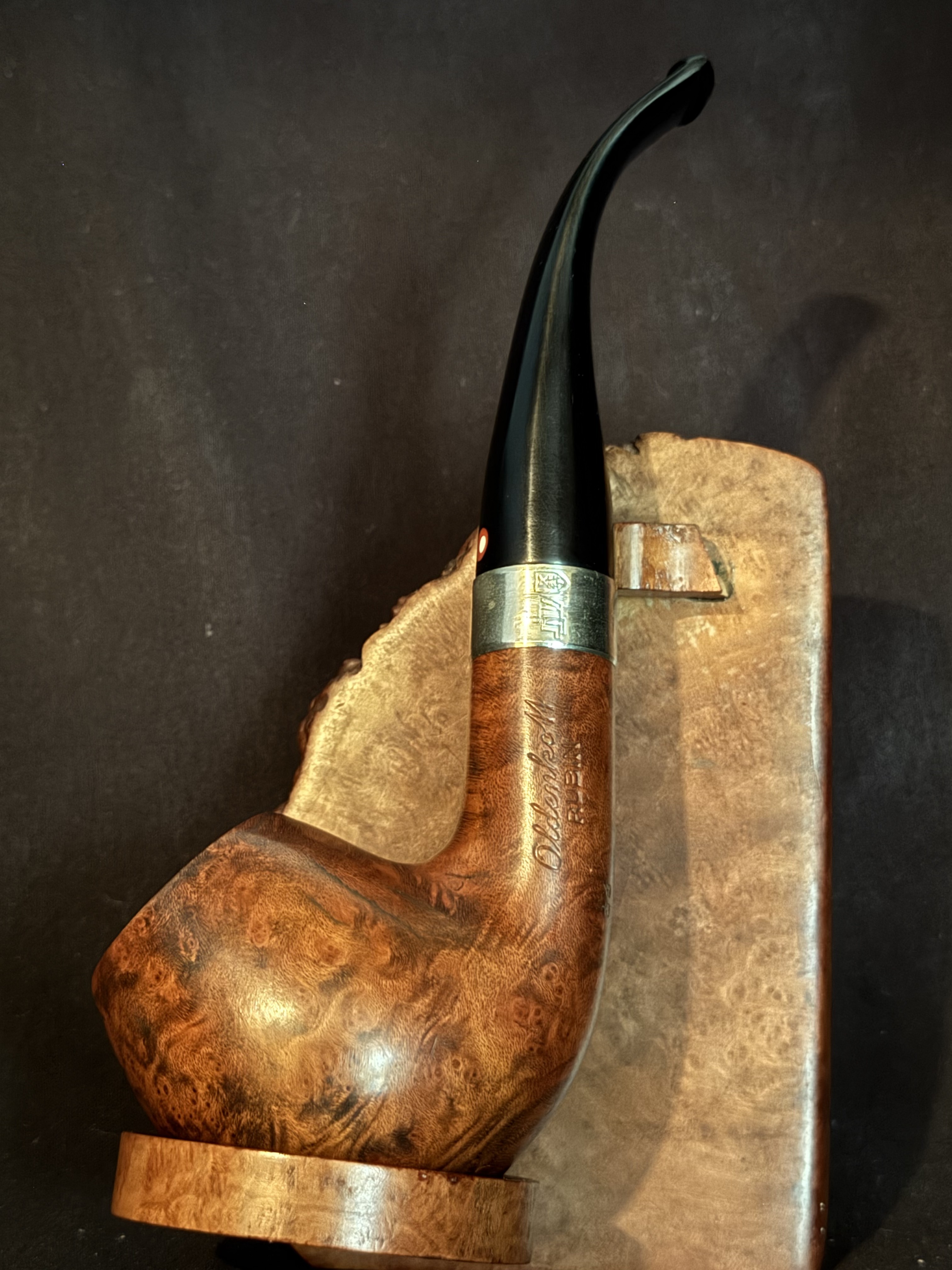
Oldenkott Rubin Bent Apple Smooth Briar Estate Pipe, Metal Band, Vulcanite Fishtail Stem
$95.00
A white dot inside a red circle sits on the stem of this pipe.
Material
Briar
Availability
Sold
Tags
Oldenkott RubinBent Apple PipeEstate PipeGerman PipeSmooth BriarVulcanite StemFishtail Bit9mm FilterMetal BandVintage PipePipe CollectorRed Dot LogoAhaus Germany
This piece has been sold and is no longer available.
Carefully Packaged
Authenticity Guaranteed
Free shipping over $150
About this Piece
A white dot inside a red circle sits on the stem of this pipe. That small emblem carries more history than its size suggests.
This is an Oldenkott Rubin, a bent apple in smooth briar, fitted with a metal band at the shank and a tapered vulcanite stem cut to a fishtail bit, bored for a 9mm filter. The seller read the stamp directly off the shank: Oldenkott Rubin.
Oldenkott's roots run back to a tobacco dynasty with origins placed at 1740 and 1760, built from two family lines, Henricus Oldenkott of Rees and Hermannus Oldenkott of Ahaus, with an Amsterdam branch house recorded in an 1918 print: "Herms, Oldenkott und Zonen in Ahaus mit einem Zweiggeschaft in Amsterdam." In 1838 August Kersten of Rees bought the Heinric Oldenkott factories at Elten and Weesp, building one of Germany's larger tobacco firms of the era. The firm's Knaster tobacco was smoked by Kruger in exile, his likeness appearing on the packets by 1901. Pipes under the Oldenkott name were advertised nationally in Berlin from 1926, and in 1929 the firm bought the Ahaus and Neuss Hermann-Oldenkott factories. German pipe production of its own began in 1932. In the postwar decades Oldenkott stood as Germany's second largest pipe maker, after Vauen. The Dutch firm Niemeijer bought the company in 1972; tobacco production stopped in 1974 and the firm became pipes only. The Kersten family bought the pipe business back in 1987, and it closed in 1992. In 2012 the marks passed to Alexander Strahnz of Cologne, who revived the name with Italian-made production on smaller bowls and slimmer shanks, and restored the historic red-and-white dot mark to the premium models of that line.
The mark on this stem, a white dot set inside a red circle, is that emblem: Oldenkott's own house mark, carried through the firm's long history and brought back for the top grades of the modern revival.
THE MARKS
- White dot inside a red circle, inlaid on the stem
- Metal band at the shank
The dot-in-circle sits on the stem rather than as a shank stamp, which is where most makers place their maker's mark. Oldenkott used the stem itself as the signature position across its history.
An apple is one of the oldest classic bowl shapes in the pipe maker's vocabulary: a rounded bowl, fuller at the belly than a billiard, with a shank that narrows as it leaves the bowl rather than running straight-walled. Bent here means the shank and stem carry the bowl downward through an arc rather than in a straight line, so the bit sits closer to the smoker's jaw and the weight rides lower in the hand. It is a shape built for the mouth more than the display stand, though a well-kept example holds its own on a rack. The tapered stem narrows steadily from shank to button, and the fishtail bit widens at the very end into two flat wings either side of the slot, a cut chosen for lip comfort over a plain round bit. The 9mm bore accepts a standard charcoal filter, a fitting more common on German-made pipes of this kind than on French or British equivalents, and it changes the draw noticeably versus an open, unfiltered chamber.
The briar is smooth, not blasted or rusticated. A smooth finish is the maker's choice when a block of briar is judged clean enough, and its grain attractive enough, to be shown rather than hidden under a textured or dark finish; it takes more care at the sanding stage, since every flaw in the wood stays visible. Color and grain figure on this bowl: see the photographs.
Condition: pre-owned, graded very good. Very small scratches are present on the briar around the bowl. No other flaws are noted.
THE MEASUREMENTS
Length 148mm (5.9") - bowl height 48mm (1.9") - bowl width 42mm (1.7") - bowl depth 40mm (1.6") - chamber diameter 20mm (0.8") - weight 1.7 oz - 9mm filter
Ships from the Faridunhill / Pipe Collectors Encyclopedia archive. Worldwide shipping and professional sanitation on every estate pipe.
SKU: 096