Loading
Loading

Estate Pipes
$85.00
Material
Briar
Availability
Only 1 left
Tags
Welcome to Pipe Collectors Encyclopedia, your premier destination for museum-quality estate pipes with comprehensive historical and technical documentation.
IDENTIFICATION
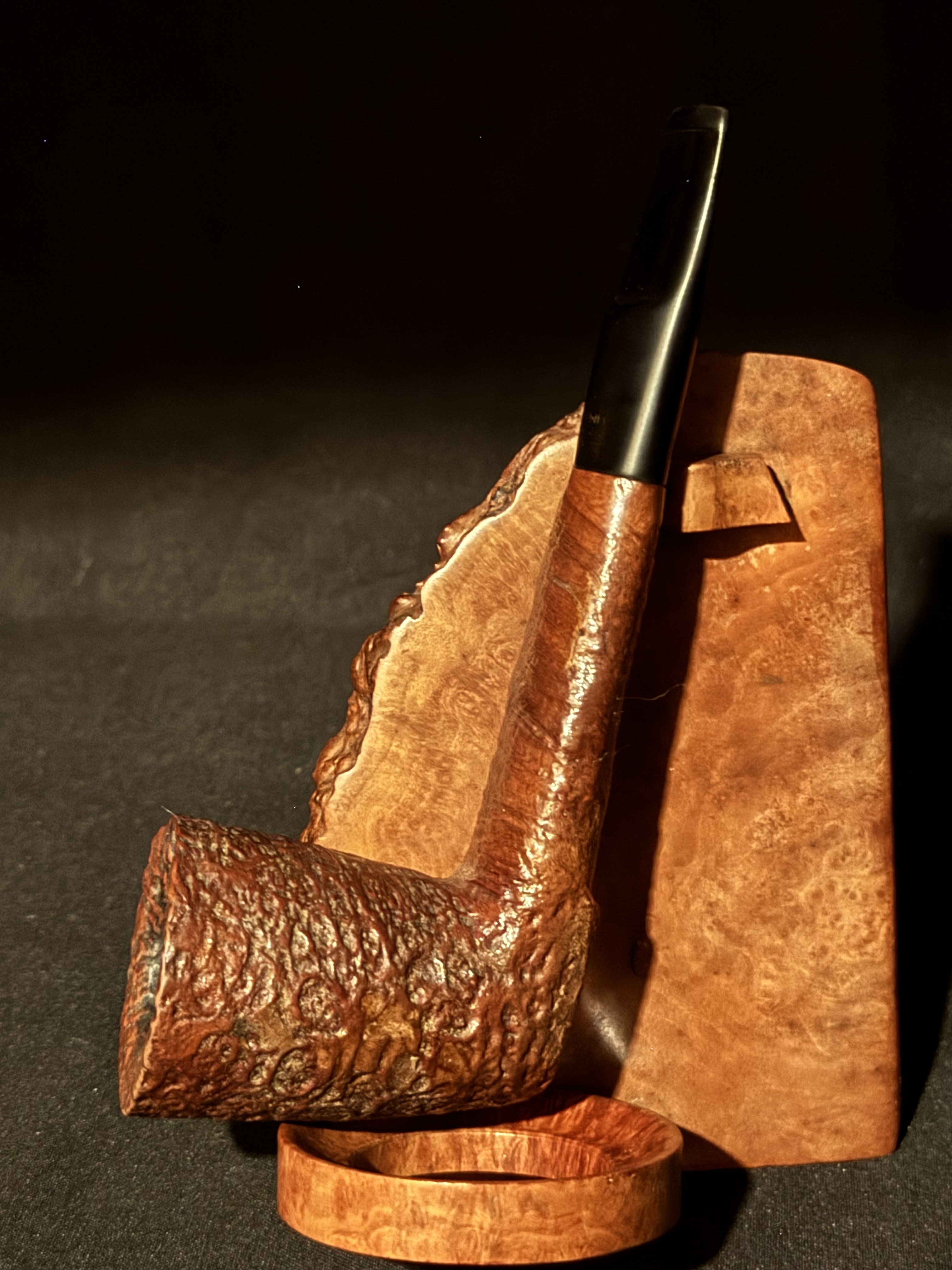
This is a Gold Eagle straight-grain dublin in sandblast finish, fitted with a vulcanite saddle stem and fishtail mouthpiece. The pipe carries a metal band at the shank junction. Gold Eagle pipes represent a significant thread in mid-20th-century European pipe manufacturing, positioned as a competent middle-tier maker for the continental market. The straight dublin configuration-a tall, upright bowl seated directly on a short, stubby shank-places this pipe squarely in the post-war comfort-smoking tradition. Sandblast finishing was a technique that gained momentum during the 1950s onward, particularly favored by German and European makers seeking to market pipes as rugged, texture-forward alternatives to smooth finishes.
HISTORICAL CONTEXT
Gold Eagle (Goldadler in German-speaking markets) emerged as a regional European pipe brand, building reputation through steady production of competently finished briars aimed at the working and middle-class smoker rather than the high-collector segment. While specific founding documentation requires confirmation, the house appears in catalogs and estate collections primarily from the 1950s through 1970s, the peak era for European briar proliferation. The maker was part of a broader cohort of smaller continental factories-alongside names like Vauen, Stanwell, and Peterson's own European subsidiaries-who supplied domestic and export markets with reliable, affordable briars. Gold Eagle pipes do not command the auction premium of Dunhill or Chacom, but they hold steady collector interest for their honest construction, clean stamping, and accessibility to new collectors building foundational estates. The dublin shape itself descends from late-Victorian Anglo-Irish design, revived with vigor in the 1930s and carrying forward through the postwar boom as a shape that favored direct, unfiltered draw and compact portability. Sandblast treatment, while labor-intensive, became a hallmark of pipes marketed as "character-forward" or "working" pipes-the texture reduced gloss and hand-feel shininess, lending a more tactile, mature appearance.
GRADING & MARKS
Stamps and maker identification: to be confirmed upon inspection. Metal band: appears to be nickel or chrome-plated brass, seated at the shank-bowl junction as a reinforce and decorative feature. Finish: sandblast (mechanical abrasion or tumble-blast technique applied to the entire outer briar surface, creating uniform matte texture). Mouthpiece: fishtail, unfiltered, vulcanite construction. Stem type: saddle stem (a rider-style vulcanite element seating atop the shank mortise, offering comfortable lip grip without full insertion). No filter conversion noted.
SHAPE ANALYSIS
The dublin is one of the classical upright shapes: a tall, cylindrical or slightly tapered bowl set perpendicular to a very short, often stubby shank, with the overall silhouette resembling a teacup on a pedestal. This example measures 128 mm in overall length, with a bowl height of 50 mm and chamber diameter of 20 mm-dimensions consistent with a traditional straight dublin proportioned for single-hand control and tabletop or desk resting. The fishtail mouthpiece extends the lip contact width, a feature often paired with straight pipes to ease clenching during work or casual sitting. Dubliners are fundamentally sidesmoke or hand-held pipes; the short shank and forward bowl weight discourage pipe-rack resting. Collectors prize dubliners for their visual boldness and their refusal of pretense-they are working shapes, and their appeal lies in sturdy geometry and honest finish.
BRIAR & FINISH
The bowl dimensions (33 mm width, 40 mm depth) suggest a moderately-grained briar blank, likely cut from Mediterranean or Algerian root stock processed into a dense, fine-textured burl. Sandblast finishing involves mechanical abrasion of the briar surface-either hand-tumbling with grit or machine-blast application-which removes the outer polish, opens micro-grain texture, and creates a uniform matte appearance. Under oblique light, sandblasted briar reveals the grain structure without glossy reflection, lending visual weight and tactile appeal. The finish is durable; unlike stains, it does not flake or wear away with hand oils and smoking. For a dublin, particularly one marketed as a sturdy estate or working pipe, sandblast is an apt choice: it signals practicality, resists visual showing of use-marks, and suits the compact, no-nonsense geometry of the shape.
CONDITION REPORT
Overall condition: very good to excellent. The seller notes "amazing vintage condition." Briar exterior: intact, no cracks or major fills visible in the photographs. The sandblast finish shows even wear consistent with age and moderate use; no deep gouges or significant scuffing are apparent. Rim: to be confirmed upon inspection. Chamber: to be confirmed upon inspection. Vulcanite stem: color and surface condition to be confirmed upon inspection; vulcanite can oxidize to a honey or amber tone over decades, and may show light tooth chatter or compression marks. Metal band: appears intact and seated securely. A comprehensive condition inspection, including internal chamber examination and stem detail, is available on request.
DIMENSIONS
- Overall length: 128 mm (5.1 inches)
- Bowl height: 50 mm (2.0 inches)
- Bowl width: 33 mm (1.3 inches)
- Bowl depth: 40 mm (1.6 inches)
- Chamber diameter: 20 mm (0.8 inches)
- Weight: 1.4 ounces
- Hole size: 9 mm
CLOSING
Ships from the Faridunhill / Pipe Collectors Encyclopedia archive. Worldwide shipping and professional sanitation on every estate pipe.
SKU: SKU-371