Loading
Estate Pipes
German Porcelain Hunter Pipe Gesteckpfeife, Painted Forest Scene, Lidded Bowl, Segmented Stem
$135.00
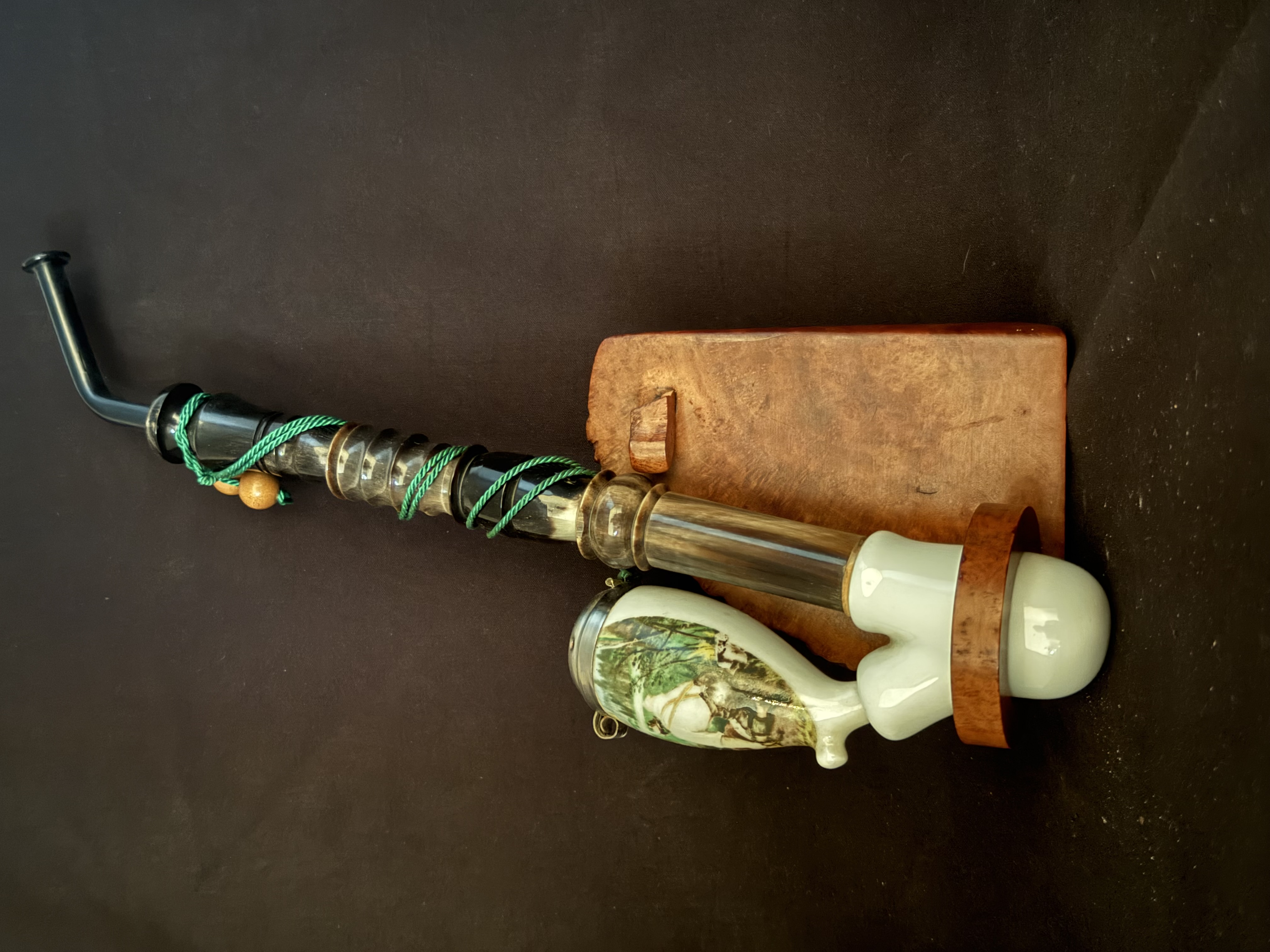
A forest scene with figures among the trees is painted around the white porcelain bowl of this pipe, under a domed metal lid.
Material
Briar
Availability
Only 1 left
Tags
porcelain pipegerman pipehunter pipegesteckpfeifejagerpfeifelidded pipeforest scene pipechurchwarden lengthpainted pipetobacco pipereservoir pipesegmented stemcollectible pipe
1
Carefully Packaged
Authenticity Guaranteed
Free shipping over $150
About this Piece
A forest scene with figures among the trees is painted around the white porcelain bowl of this pipe, under a domed metal lid. It is a traditional German hunter's pipe, a Gesteckpfeife, built in parts that come apart: the painted bowl, a glossy white porcelain reservoir, a long stem of several turned sections and a bent black mouthpiece.
The lid is hinged and closes with a wire catch. The stem is made of a long mottled gray-brown section and black turned sections, one of them with spiral ribs, and the sections join on brass-colored threaded studs. Where the stem fits into the reservoir, its end is covered in cork. A green cord with two round wooden beads is tied at the upper stem. No maker's stamp is on the pipe and no date is given for it. Please see the photographs for its condition.
In German these pipes have two names. Gesteckpfeife means a composite pipe, one that is put together from several pieces; Jägerpfeife means the hunter's pipe. They come from the Alps, from Bavaria and from the Black Forest, and during the eighteenth and nineteenth centuries they became common, a symbol of status and a part of popular culture at the same time.
What sets them apart is the multi-piece build around the reservoir, called the Abguss. This ceramic base holds the mouthpiece side of the pipe, and it works as a trap: moisture and tar from the smoke collect in it before they can reach the mouth. Some smokers of the past even poured a little wine into it to flavor the smoke. Long stems belong to the type, often cut from cherry wood (Weichselholz) or from deer or elk antler, some of them flexible, and some wrapped in colorful braided threads and cords finished with tassels.
The bowls were painted with German wildlife and German life. The hunting and nature scenes are the most famous: deer, elk, wild boar, foxes and hunting dogs in the forests, the culture of the Jäger. Reservistenpfeife were commemorative pipes for army officers, with dates, coats of arms and the names of battalions on the porcelain. Social life appears too, with men in traditional Bavarian dress and landscapes of cafes and bars.
Next to briar or pure clay, porcelain is a completely neutral material, so it does not change the flavor of the tobacco. The price of that purity is care, because porcelain is fragile. Clean the bowl gently and only after it has cooled completely, so that the carbon deposits inside do not expand and crack it. The chamber of this bowl is 19 mm wide and 54 mm deep.
THE MARKS
- No maker's stamp
THE MEASUREMENTS
- Length: 275 mm (10.83 in)
- Bowl height: 60 mm (2.36 in)
- Bowl width: 32 mm (1.26 in)
- Chamber diameter: 19 mm (0.75 in)
- Chamber depth: 54 mm (2.13 in)
- Weight: 116 g (4.09 oz)
Ships from the Faridunhill archive. Worldwide shipping and professional sanitation on every estate pipe. SKU: 598