Loading
Estate Pipes
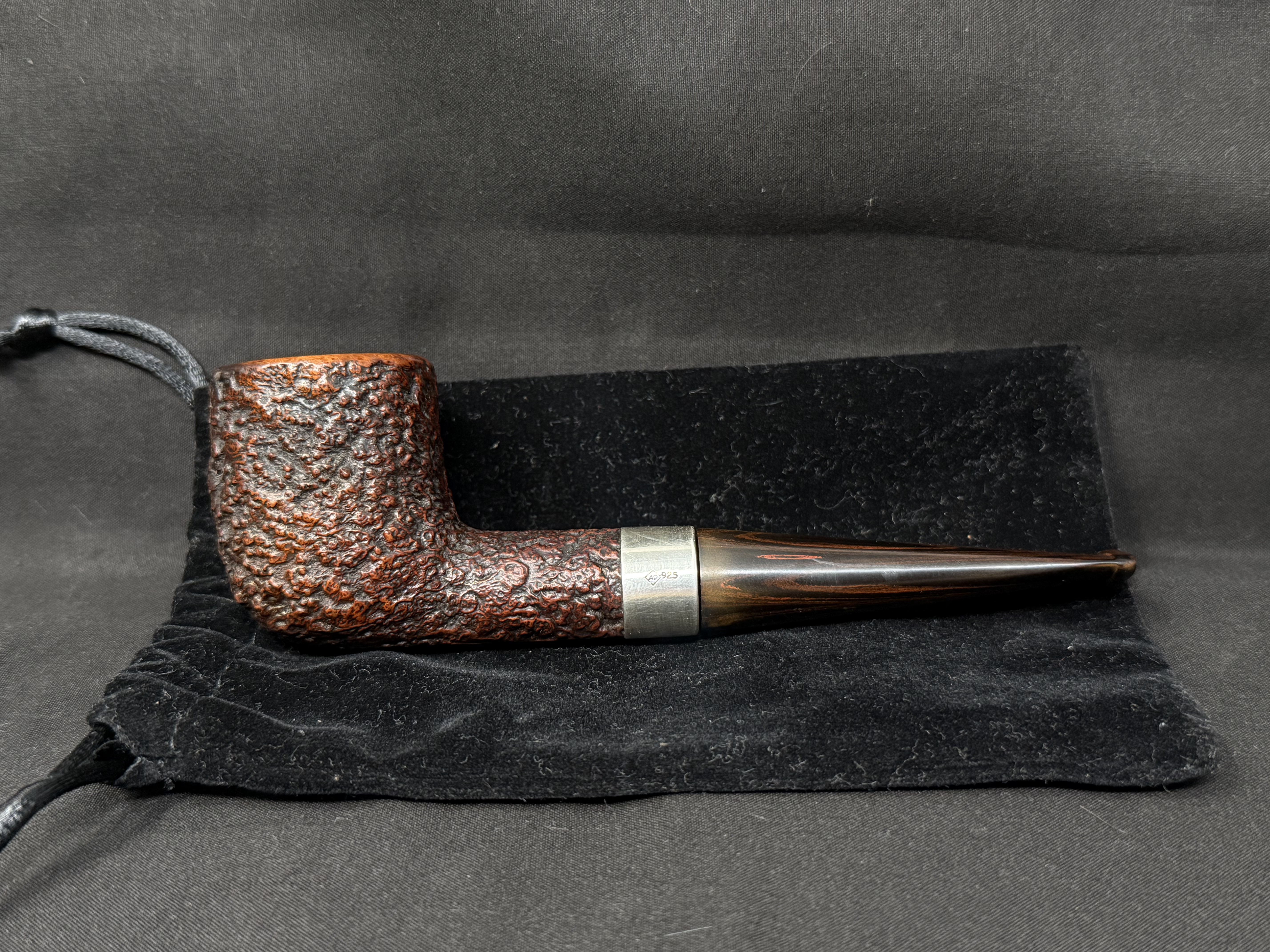
Dunhill Cumberland 41031 Billiard Sandblast Straight Estate Pipe, Silver Band
$425.00
Material
Briar
Availability
Sold
Tags
Dunhill pipeCumberland billiardsandblast finishestate pipevintage tobaccoLondon pipesilver bandcollector pipebriar pipestraight billiardpipe 41031English pipesmoking pipe
This piece has been sold and is no longer available.
Carefully Packaged
Authenticity Guaranteed
Free shipping over $150
About this Piece
Welcome to Pipe Collectors Encyclopedia, your premier destination for museum-quality estate pipes with comprehensive historical and technical documentation.
IDENTIFICATION
This is a Dunhill Cumberland 41031, a no-filter straight billiard finished in sandblast with a sterling silver band. The Cumberland line represents one of Dunhill's core catalog offerings from the mid-20th century forward, and this piece carries the hallmarks of that era's production standards. The 41031 designation places it within Dunhill's systematic shape-and-size cataloging system, while the sandblast finish was among the most durable and visually distinctive options offered across the range.
HISTORICAL CONTEXT
The Dunhill pipe company was founded in 1907 by Alfred Dunhill in London, initially as a tobacconist and leather-goods house before pipe manufacturing became central to the brand's identity. By the 1920s, Dunhill had established itself as a maker of premium handmade pipes, competing alongside Barling, Ashton, and other London-based manufacturers. The Cumberland line emerged as a workhorse catalog line, representing Dunhill's commitment to accessible quality-pipes that carried the maker's reputation for careful briar selection and finish execution without commanding the premium prices of the company's hand-carved or highly figured wood offerings.
Dunhill's shape numbering system, formalized by the mid-20th century, assigned each shape a four-digit code. These codes reflected both the shape family and the size within that family, allowing retailers and collectors to specify exact models with precision. The billiard shape itself-a straight, cylindrical bowl with a flat bottom and a shank that tapers gently downward-was and remains one of the most fundamental forms in pipemaking. For Dunhill, the billiard represented a versatile platform: comfortable to hold, stable when rested, and equally at home in a formal setting or casual rotation.
The sandblast finish, while common in mid-20th-century production, requires considerable skill to execute well. The process involves directing a stream of fine abrasive particles at the briar surface under pressure, creating a uniform texture that masks grain irregularities and provides tactile interest. At Dunhill, sandblast finishing was applied to briar selected for structural quality rather than figure, making it an economical choice without sacrificing durability. Collectors prize sandblast Dunhills for their visual warmth, their resistance to dings and wear marks, and the way the finish ages into deeper tones with decades of use.
GRADING AND MARKS
Markings to be confirmed upon inspection. Standard Dunhill stamps of this era typically include: maker name (DUNHILL) and country of origin (LONDON or MADE IN ENGLAND), shape number (41031), and grade designation (ranging from group numbers indicating quality tier). Any hallmarks on the silver band will be documented and interpreted.
SHAPE ANALYSIS
The billiard is among the oldest and most refined pipe shapes in the canon. The 41031 iteration presents the classical form: a straight, vertically oriented bowl with a cylindrical internal chamber, paired with a downward-tapered shank and stem assembly. The bowl's proportions-height relative to diameter-determine how the pipe feels in the hand and how the smoke travels; a well-proportioned billiard sits comfortably clenched or held between the teeth, and the straight line of the shank ensures stable resting when laid down. Dunhill's billiards have historically been favored for their balance and their neutral aesthetic, which complements rather than dominates a smoker's presentation. The no-filter designation (common in Dunhill's numbering) indicates this pipe was never fitted with internal filtering mechanisms; it is a pure briar-and-stem design.
BRIAR AND FINISH
The briar body consists of Mediterranean heath-root, selected and aged according to Dunhill's standards. The sandblast finish creates a uniform matte surface, textured to the touch, which obscures grain variation and minor surface flaws while emphasizing the inherent color of the wood-typically warm tan to medium brown depending on the specific briar lot. Under light, a well-executed sandblast shows subtle tonal variation and a slight sheen where the abrasive pattern catches light. The finish is inherently durable, resisting burnish marks and small dings that would be visible on a smooth or stained surface. The sterling silver band, traditionally affixed at the shank-stem junction, serves both structural and aesthetic purposes: it reinforces the junction against cracking and provides a formal visual accent.
CONDITION REPORT
To be confirmed upon inspection. Upon receipt, this pipe will be examined for: chamber integrity and any internal cake buildup or damage; rim condition (any charring, chips, or wear to the edge); external briar condition (cracks, fills, repairs, or structural compromises); stem condition (oxidation, tooth marks, fractures, or previous repairs); and overall structural soundness. Any repairs, fills, or restoration work will be documented with precision. The sandblast finish will be assessed for original texture, any burnished areas, or finish loss.
DIMENSIONS
To be confirmed upon inspection:
* Overall length: [measurement]
* Bowl height: [measurement]
* Bowl diameter (rim): [measurement]
* Chamber depth: [measurement]
* Chamber diameter: [measurement]
* Weight: [measurement]
CLOSING
Ships from the Faridunhill / Pipe Collectors Encyclopedia archive. Worldwide shipping and professional sanitation on every estate pipe.