Loading
Estate Pipes
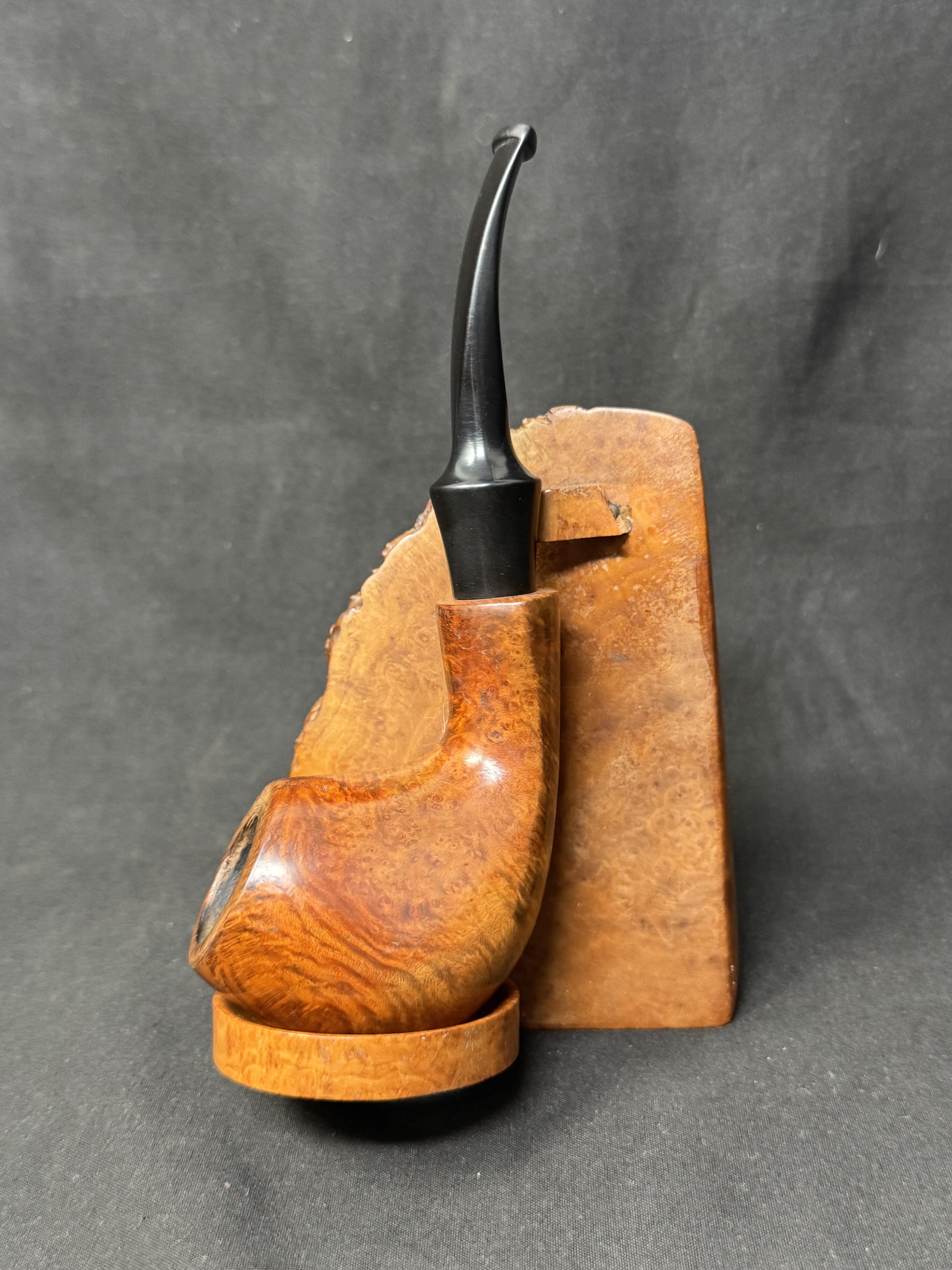
Danish Freehand Smooth Bent Billiard Estate Pipe, Semi-Oval Shank, 9mm Filter
$65.00
Material
Briar
Availability
Sold
Tags
estate pipebent billiardDanish briarsmooth finishvintage pipefreehandvulcanite stem9mm filtercross grainbird's eyesaddle stemfishtailcollector pipe
This piece has been sold and is no longer available.
Carefully Packaged
Authenticity Guaranteed
Free shipping over $150
About this Piece
Welcome to Pipe Collectors Encyclopedia, your premier destination for museum-quality estate pipes with comprehensive historical and technical documentation.
IDENTIFICATION
This is a smooth bent billiard of freehand design, produced in the Danish briar tradition. The maker's name is not legible on the stem or shank. The pipe exhibits hallmark characteristics of mid-twentieth-century Danish pipe-making: cross-grain and bird's-eye finish, careful shank geometry, and functional 9mm filter integration. No catalog model number or date marking is evident.
HISTORICAL CONTEXT
Denmark became a major center of briar pipe manufacture in the early twentieth century, building on a foundation of Scandinavian woodworking craft and proximity to Mediterranean briar supplies via northern trade routes. Danish makers earned international respect for consistent bowl geometry, refined saddle-stem construction, and distinctive finishing techniques that emphasized wood grain rather than stain. The smooth finish tradition--allowing grain character to emerge through hand-sanding and careful selection--became a signature of the Danish school.
The bent billiard itself is one of the oldest and most enduring shapes in briar history. It appears in catalogs from the 1890s onward across English, Continental, and Scandinavian makers. The bent billiard's short, upright bowl and angled shank make it equally suited to pocket carry and desktop display. Danish manufacturers, in particular, refined the bent billiard through systematic variation: some kept shanks perfectly circular, others--as in this pipe--adopted semi-oval or flattened profiles for improved ergonomics and visual distinction.
The freehand classification indicates this pipe was not turned against a mechanical template but rather shaped by eye and hand. Freehand work is labor-intensive and typically reserved for higher-grade lines. It signals the maker's confidence in material quality and the finisher's skill in reading grain and compensating for wood irregularities in real time. Collectors value freehand pieces for their individuality and for what their existence reveals about the maker's workshop standards.
GRADING & MARKS
No maker nomenclature, grade stamp, or country marking is legible on examination. Identification as Danish is inferred from finish technique, shank construction, and grain presentation rather than from stamped attribution. To be confirmed upon inspection: whether any stampings become visible under magnification or in raking light.
SHAPE ANALYSIS
The bent billiard presents a classic geometry: upright, cylindrical bowl with a pronounced bend at the shank junction. This pipe's distinguishing feature is its semi-oval shank--half-circular in cross-section when viewed from above, with slight downward curvature when viewed from the side. This hybrid geometry is neither fully rounded nor fully flattened, a refinement favored by Danish makers seeking to balance ergonomic grip with visual lightness. The vulcanite saddle stem--a fitted piece set into the shank end--was the standard means of joining bowl to mouthpiece across Scandinavia. The fishtail mouthpiece, splayed at the end, distributes pressure across a wider contact surface and is gentle on the lips during extended smoking. The 9mm filter chamber at the stem base is a later convenience, indicating this pipe post-dates the 1960s by at least a decade, when filter standardization became routine.
BRIAR & FINISH
The briar shows pronounced cross-grain and bird's-eye patterning, evidence of careful wood selection and quarter-sawn or bastard-sawn cutting that exposes medullary rays and growth-ring undulation. Cross-grain appears when the grain runs diagonally across the bowl face; bird's-eye, when small knots or grain irregularities create discrete circular or oval patterns under the finish. These effects emerge through the smooth finish technique: briar is hand-sanded progressively finer (typically 220 to 400 grit or higher), then sealed with a clear or light stain that allows the wood itself to define the visual character. No darkening stain obscures the grain. Under raking light, the smooth finish will reveal the wood's natural depth and the finisher's patience in achieving uniform surface texture. This approach to finishing is resource-intensive and signals a maker's commitment to wood quality over cost reduction.
CONDITION REPORT
Overall grade: Very good. The pipe shows minimal wear consistent with light to moderate estate use. Rim: even, no rim char or burn-through visible. Chamber: to be confirmed upon inspection; visual access is limited without removal of the stem. Stem: vulcanite saddle stem intact, no fractures or major oxidation apparent; bite marks or surface oxidation to be confirmed upon detailed inspection. No fills, repairs, or structural damage are evident in the photographs. To be confirmed upon inspection: microscopic tooth chatter on the stem, minor oxidation patina on the vulcanite, or any hidden damage to the shank interior.
DIMENSIONS
* Overall length: 140 mm (5.6 inches)
* Bowl height: 45 mm (1.8 inches)
* Bowl width: 40 mm (1.6 inches)
* Bowl depth: 40 mm (1.6 inches)
* Weight: 1.8 oz (51 grams)
These measurements indicate a compact, portable pipe--suitable for both pocket and display. The bowl's near-cubic proportions (width and depth nearly equal, height slightly greater) confirm the billiard classification.
CLOSING
Ships from the Faridunhill / Pipe Collectors Encyclopedia archive. Worldwide shipping and professional sanitation on every estate pipe.
SKU: SKU-300