Loading
Estate Pipes
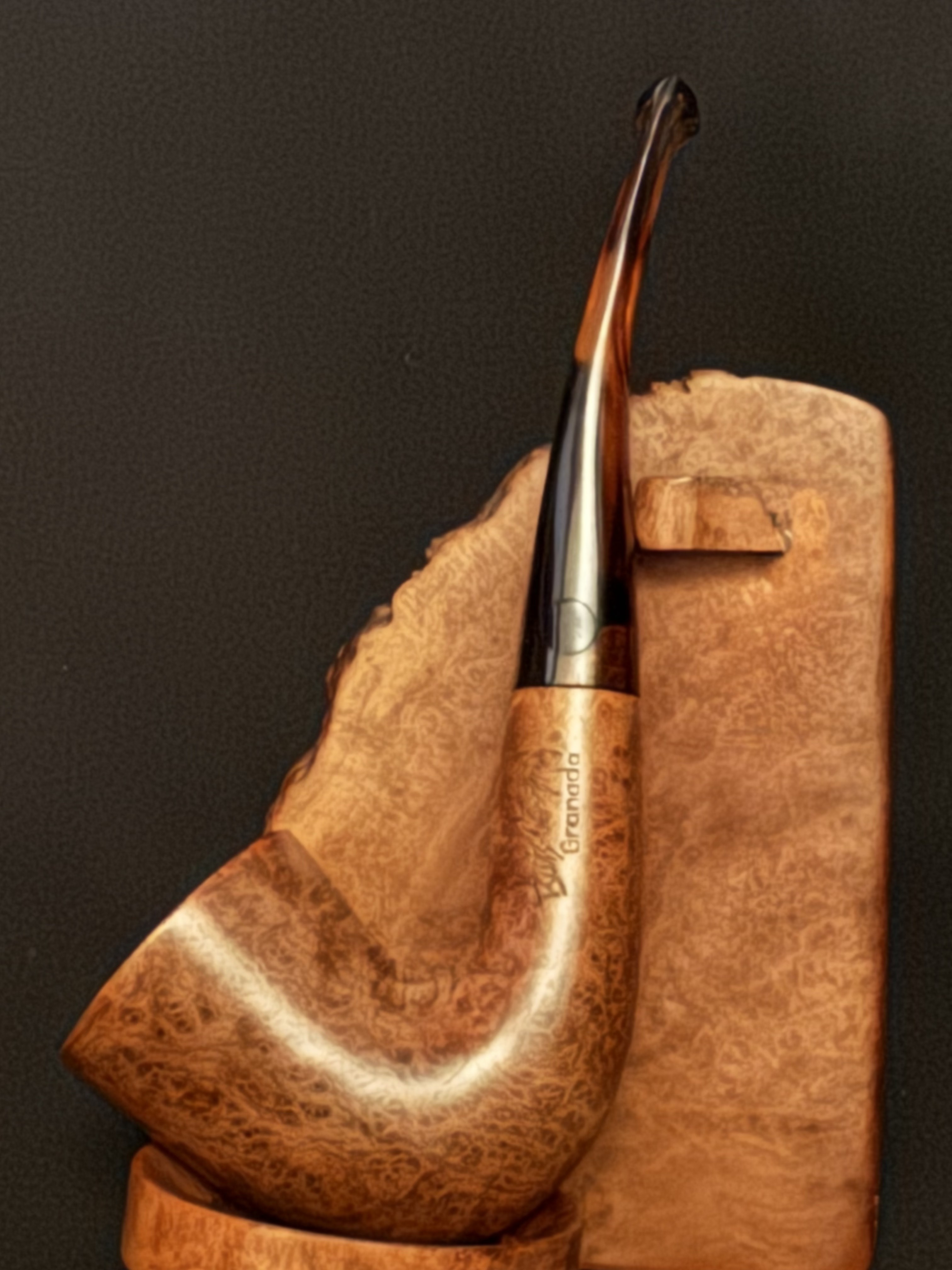
Butz-Choquin Granada 1283 E Bent Dublin Smooth Estate Pipe
$95.00
Material
Briar
Availability
Sold
Tags
Butz-Choquinestate pipebriar pipeDublin bentFrench pipeSaint-Claudevintage pipesmooth finishacrylic stem1283 Epipe collectorGranada modeltobacco pipe
This piece has been sold and is no longer available.
Carefully Packaged
Authenticity Guaranteed
Free shipping over $150
About this Piece
Welcome to Pipe Collectors Encyclopedia, your premier destination for museum-quality estate pipes with comprehensive historical and technical documentation.
IDENTIFICATION
Butz-Choquin Granada, model 1283 E, bent dublin form with smooth briar finish and acrylic tapered stem. Saint-Claude production, pre-smoked estate condition. The 1283 E represents the maker's mid-range catalog work during the modern Saint-Claude era, a period when Butz-Choquin had established itself as a consistent producer of well-proportioned utility and collectable pipes for export markets.
HISTORICAL CONTEXT
Butz-Choquin traces its heritage to 1858 in Metz, France, where tobacconist Jean-Baptiste Choquin and his son-in-law Gustave Butz (married to Choquin's daughter that year) began crafting bent pipes with distinctive flat-bottomed bowls and hollow albatross-bone mouthpiece extensions fixed with silver rings. This Origine model became iconic enough that painter Jean-Baptiste-Camille Corot was photographed smoking one by the photographer Nadar-an image the house later used in its own advertising. For nearly a century, Butz-Choquin pipes were crafted or distributed by various makers, including Berrod-Regad itself, which held distribution rights across much of Europe. In 1951, the turning point came: Berrod-Regad purchased the Butz-Choquin trademark outright, and production relocated from Metz to Saint-Claude, the pipe-making capital of France's Jura region. This move coincided with a modernization of the catalog. By 1960, Butz-Choquin had entered the export market in earnest, rebuilding its international dealer network and expanding its collection from 10 to 70 distinct numbered series. The Granada line, represented here by the 1283 E, sits within this mid-range catalog tier-neither the artisan Maitre Pipier series (hand-carved by Paul Lanier) nor the top-tier Collection line (with its three-star grading system and maker's marks by Alain Albuisson), but rather the honest, well-finished daily smokers that drove the brand's post-war reputation. Jean Paul Berrod oversaw this period from 1969 to 2002, nurturing the house's standing among French smokers and collectors alike. The smooth finish on this example represents the standard aesthetic of Granada-series pipes: unadorned briar with careful sanding and polishing, designed to highlight grain without the labor or cost of carving.
GRADING & MARKS
* Stamp (left face): 'Butz-Choquin' - maker name, Saint-Claude era (post-1951 standard).
* Stamp (right face): 'St Claude France' and model number '1283 E' - location, country of manufacture, and catalog designation.
* No pre-1951 Metz mark present; no Collection-line grading stars; no 'Fait main' or artisan carver attribution.
* Mouthpiece: acrylic tapered stem, no filter conversion, fishtail opening - original specification for the model.
SHAPE ANALYSIS
The Dublin is a bent form with a moderately curved shank and a bowl that sits at roughly a 45-degree angle relative to the hand. The bowl itself is broad and shallow, designed for quick, cool smoking and ease of cleaning. This particular example measures 130 mm in length overall, with a bowl height of 45 mm and width of 35 mm-proportions well within the compact-to-mid-range Dublin category. The tapered acrylic stem reduces in diameter toward the mouthpiece and is finished in a colored (non-black) tone, a common aesthetic choice for Granada-series pipes of this period. The fishtail mouthpiece opening (a flared, boat-shaped bite) was standard on many Butz-Choquin models and offers a wider, gentler contact point than a traditional rounded stem. The bent orientation makes the Dublin suitable for seated smoking or brief hand-held use; the shallow bowl encourages frequent knocking and is forgiving of packing density.
BRIAR & FINISH
The briar employed here is a straight-grain or lightly figured stock, selected for its stability and uniform color. The smooth finish-a polished, uncarved surface-requires careful grain selection and precise sanding to be successful; any hidden weakness in the wood or inconsistent density will telegraph through. Saint-Claude smooth pipes of this era typically employed a light stain and wax or oil finish to enhance grain visibility and provide durability. The finished surface should show natural briar color, ranging from honey-tan to medium brown, with the grain running vertically or diagonally across the bowl face. A smooth finish of this caliber places the burden of visual appeal on the briar itself rather than on carver's artistry, making wood selection critical. The Granada line's reputation rested partly on this honest presentation: what you see is what you get, with no artistic tricks to conceal lesser grain.
CONDITION REPORT
Overall condition: pre-smoked, very good. Rim shows darkening consistent with use, likely a carbon ring or rim stain from smoking. The briar surface exhibits faint scratches and shows the expected minor wear of an estate pipe in regular use; no major gouges, cracks, or structural damage noted. The bowl chamber appears clear and open. The acrylic stem displays tiny dents-small impact marks or pressure marks from clenching-but no fractures, splits, or tooth chatter. No visible repairs, fills, or stem replacements. The fishtail mouthpiece is original and unaltered. Weight at 1.25 ounces is consistent for a Dublin of this size.
DIMENSIONS
* Overall length: 130 mm (5.2 inches)
* Bowl height: 45 mm (1.8 inches)
* Bowl width: 35 mm (1.4 inches)
* Bowl depth: 40 mm (1.6 inches)
* Chamber diameter: 20 mm (0.8 inches)
* Weight: 1.25 ounces
CLOSING
Ships from the Faridunhill / Pipe Collectors Encyclopedia archive. Worldwide shipping and professional sanitation on every estate pipe.
SKU: SKU-065